


Dear readers,
Discovering alien life—even microbial—would rank among the most consequential events in human history. Its implications would ripple across science, philosophy, and religion.
In science, finding alien life could revolutionise our theories of biology and evolution. It would show that life is a common outcome in the Universe, not a rare event on Earth. Philosophically, humanity would be compelled to question long-held assumptions about our uniqueness. It would also force us to reconsider what it means to be alive, conscious, or intelligent. Religious traditions might seek new interpretations or embrace broader views of creation and our relationship to the cosmos.
Such a discovery would force us to rethink our place in the Universe, our ethics, and our responsibilities as a species capable of reaching other worlds.
While we have yet to find definitive proof of extraterrestrial life, our own cosmic backyard—the solar system—offers tantalising possibilities. Right here in our celestial neighbourhood, several worlds harbour the ingredients for life as we know it—liquid water, organic chemistry and steady energy sources.
From hidden oceans beneath frozen moons to the enigmatic clouds of Venus, scientists have identified a select few places where life, in its humblest forms, might be lurking. They are searching for resilient extremophiles—microbes tough enough to survive in deep oceans, lofty clouds, or beneath blankets of ice.
Detecting biosignatures—the fingerprints of life—means looking for gases such as methane or oxygen in unusual amounts, telltale organic compounds commonly produced by living organisms, and fossilised cells or other textures and shapes that point to biological activity.
Come along as we explore the solar system’s most promising destinations, where alien life may be waiting to amaze us.
1. Mars: The Classic Candidate
Mars has long been the prime suspect in the search for alien life. Billions of years ago, the Red Planet was warmer, wetter, and possessed a thicker atmosphere—conditions that could have supported microbial life. Today, evidence suggests that liquid water may still exist beneath the Martian surface.
NASA’s Perseverance rover, which arrived in 2021, is collecting samples from ancient lakebeds that may contain signs of microbial life. Perseverance has found the strongest evidence yet that Mars was once habitable — and may have preserved signs of ancient life. The combination of organics, lake sediments, and water-altered minerals makes it the most compelling astrobiological site ever explored.
NASA is designing the Mars Sample Return mission to retrieve Perseverance’s samples and return them by the 2030s. These scientifically rich samples, now cached on Mars, could definitively answer whether Mars ever had life.
2. Europa: A Hidden Ocean World
Jupiter’s moon Europa is one of the most exciting places to search for life beyond Earth. Beneath a crust of water ice estimated to be 10 to 15 miles thick lies a global ocean containing twice as much water as all of Earth’s oceans combined. Jupiter’s tidal pull keeps this ocean liquid, and hydrothermal vents on its floor could provide the energy and nutrients life needs.
Scientists have spotted water plumes bursting from Europa’s surface, which could allow future missions to sample its hidden ocean without drilling through miles of ice. Observations have also revealed essential elements for life—carbon, nitrogen, and oxygen—scattered across its surface.
NASA’s Europa Clipper, launched in 2024, is expected to reach Jupiter and begin orbiting Europa in 2030. Over the following years, it will make about 50 close flybys, each with distinct goals: mapping the ice shell in detail, sampling the thin atmosphere for signs of habitability, analysing the surface and subsurface chemical composition, and searching for key evidence of an ocean capable of supporting life.
By combining data from each phase, scientists hope to determine whether Europa’s hidden ocean could harbour life and identify the most promising sites for future landing missions. Several concepts are in development for a cryobot—a robot that can penetrate thick layers of ice—and a hydrometry—a robot that travels underwater—to explore the mysterious waters autonomously.
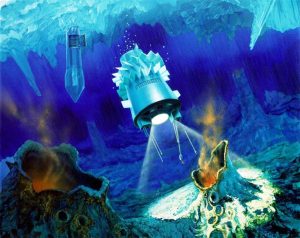
Illustration of the cryobot and its deployed hydrometry submersible exploring Europa’s ocean. Credit: NASA
3. Enceladus: A Tiny Moon with Big Potential
Saturn’s tiny moon Enceladus, only 500 kilometres across, stunned scientists in 2005 when NASA’s Cassini spacecraft detected geysers of water vapour and ice erupting from one of its poles. The plumes contained water ice, complex organic molecules and inorganic salts, suggesting that Enceladus’ subsurface ocean may host active hydrothermal chemistry capable of supporting the building blocks of life.
Enceladus is particularly compelling because its plumes let us sample its subsurface ocean directly. Future missions could soar through these jets, searching for signs of life, making this little moon one of the most inviting and accessible places to hunt for extraterrestrial organisms.
ESA is actively developing the L4 mission, a combined orbiter and lander designed to investigate Enceladus’ habitability. It will launch in the early 2040s and arrive in the 2050s, carrying the first lander ever sent to this intriguing world.
Illustration of hydrothermal activity on Enceladus’s ocean floor. Credit: NASA/JPL-Caltech
4. Titan: A World of Organic Chemistry
Saturn’s largest moon is unique in the solar system for its thick atmosphere and for being the only world, besides Earth, with lakes and seas on its surface. However, Titan’s rivers and lakes brim not with water but with the hydrocarbon compounds methane and ethane, creating a landscape rich in organic molecules.
While its surface is far too cold for life as we know it, scientists speculate that exotic life forms could exist in Titan’s lakes. These life forms might have a fundamentally different biochemistry from Earth’s—perhaps using methane or ethane as a solvent instead of water, or relying on entirely different chemicals to build their structures and store energy.
NASA’s Dragonfly mission, scheduled to launch in 2028, will travel to Titan to explore its surface and determine whether this alien world could harbour life. Dragonfly will be the first nuclear-powered flying drone to soar across another world, marking a bold leap in planetary exploration.
Dragonfly will hop to several locations, deploying its scientific instruments to analyse samples, search for complex organic molecules, and seek chemical clues to life. By flying across Titan’s varied landscapes, it will help us determine whether this cold, organic-rich moon’s composition may mirror that of early Earth.
Illustration of the Dragonfly spacecraft on Titan’s surface. Credit: NASA/Johns Hopkins APL
5. Venus: Life in the Clouds?
Closer to home, Venus might appear the most inhospitable place for life. Its surface is hot enough to melt lead, and its atmosphere is both crushing and acidic. Yet scientists propose that microbial life could find refuge in the temperate cloud layers 50 kilometres above the surface, where sunlight is abundant, and temperatures and pressures are more Earth-like.
Future missions such as NASA’s DAVINCI and VERITAS, along with ESA’s EnVision, will study Venus in greater detail. DAVINCI, planned to launch in 2031, will include an orbiter to image Venus from above and a lander to study its atmospheric composition and take photographs during descent. The following year, EnVision will set off to conduct surface, subsurface and atmospheric studies. VERITAS is scheduled to launch between 2035 and 2037, aiming to map the entire planet with radar and infrared instruments to study its geology, creating a global 3D map of Venus’s surface and gravity field.
Illustration of the VERITAS spacecraft orbiting Venus. Credit: NASA/JPL-Caltech
6. Ceres and Other Dwarf Planets
Ceres, the largest body in the asteroid belt, might harbour a hidden ocean or pockets of salty water beneath its surface. In 2017, NASA’s Dawn mission detected organic compounds and signs of recent geological activity, hinting at possible habitability. Still, any life here would be microbial and buried deep underground. Ceres is tiny—just 940 km wide—and has lost most of its heat, so any liquid water would exist as cold, isolated pools rather than a global ocean like Europa or Enceladus.
Similarly, Pluto and other icy bodies in the outer solar system might conceal oceans beneath their surfaces. Life on Pluto is extremely unlikely—but not completely impossible. It is one of the harshest environments in the Solar System. Yet, a few of NASA’s New Horizons discoveries in 2015 leave the door slightly open for exotic, deeply buried microbial life.
New Horizons didn’t find life on Pluto. Still, it revealed that the dwarf planet possesses the key ingredients for habitability—liquid subsurface water, organic molecules, and energy—beneath its surface, making it a fascinating target for future study.
An extraordinary journey
The quest to find alien life in our solar system remains one of science’s most thrilling frontiers. Although we have yet to uncover definitive evidence, scientists agree that proof would require more than hints such as unusual chemistry or potential biosignatures.
Definitive evidence would be unmistakable signs, such as living cells or fossils under a microscope, complex organic molecules assembled in ways only life can produce, or direct observation of biological activity. No single measurement would suffice. Instead, scientists would need to combine several lines of evidence to build a convincing case for life.
For example, unusual methane levels in a planet’s atmosphere might raise questions, but to confirm life, researchers would look for supporting clues like organic molecules shaped by biological processes, microfossils in rock samples, and chemical imbalances that known geology alone cannot explain. By gathering this converging evidence, each piece reinforcing the others, scientists could provide strong proof for independent verification and scientific consensus.
Still, the diversity of potential habitats, from Martian aquifers to Europan oceans to Venusian clouds, suggests that life could be more varied than we ever imagined. As new missions bring us closer than ever to revealing these worlds’ secrets, we stand on the brink of discoveries that could transform our understanding of life itself.
Whether we encounter surprises or disappointments, this journey of discovery promises to be extraordinary.
Discover more here: Could We Find Alien Life In Our Cosmic Backyard?
 imunify-bot-check