


The hunt for alien technologies, or the search for technosignatures, stands as one of the most exhilarating frontiers in astrobiology and astrophysics.
Beyond seeking traces of extraterrestrial life (biosignatures), scientists sweep the cosmos for the unmistakable fingerprints of advanced engineering—structural, chemical, or electromagnetic clues left behind by alien minds.
Without confirmed examples to study, scientists and engineers blend imagination with the laws of physics, expanding the range of possibilities for what alien technologies might be. Their visions fall into categories shaped by the energy sources and scientific principles that aliens might exploit.
How Science Classifies Alien Technologies
Staying true to the laws of physics, scientists envision the marvels an advanced civilisation might create. These concepts typically fall into four sweeping categories, each shaped by its scale and purpose:
- Megastructures
- Dyson Spheres: Proposed by the British physicist Freeman Dyson. A truly advanced civilisation might build a swarm of solar-collecting satellites around its star, capturing nearly all of its energy.
- Shkadov Thrusters: Proposed by the Russian aircraft engineer Leonid Shkadov. Stellar engines might be built near a star to redirect its radiation pressure, effectively turning the entire star system into a spacecraft to move through the galaxy.
- Communication
- Radio and Optical Signals: For decades, organisations such as SETI (the Search for Extraterrestrial Intelligence) have searched the skies for targeted radio signals or pulsed lasers that extraterrestrial civilisations might send toward Earth.
- Neutrino or Gravitational Wave Beams: Highly advanced technology might use streams of weakly interacting particles, such as neutrinos or manipulate gravitational waves to achieve instantaneous communication.
- Space Travel
- Nuclear Pulse Rocket: An alien spaceship might use nuclear bomb pulses for propulsion. Alternatively, they might use antimatter-triggered fusion pulses for higher efficiency.
- Bussard Ramjet: A spacecraft would gather interstellar hydrogen with a vast magnetic field, compress it, and fuse it to produce thrust.
- Warp Drive: A ship would contract space in front of it and expand it behind it, allowing faster-than-light travel without violating local light-speed limits.Wormholes: These hypothetical shortcuts through spacetime could allow an alien civilisation to connect distant regions of space by holding a wormhole open with exotic matter.
- Information & Computation
- Matrioshka Brain: Several Dyson spheres nested in computational layers. The innermost layer operates at high temperatures, and each outer layer recycles waste heat for additional computing.
- Black Hole Computer: A theoretical ultimate computer could use Hawking radiation from a microscopic black hole, encoding information by altering the black hole’s physical properties.
How Science Fiction Describes Alien Technologies
Science fiction describes alien technologies in fascinating ways, often defined by how alien they are—either as a terrifyingly superior version of our own tools, or as something so fundamentally different that it challenges our definition of life and technology itself.
1. The Grand Fleet & Interstellar Warships
- Conquest & Defence Motherships: The Rom-Ghenshar rule the stars with their “invincible” Grand Fleet, commanded by legendary leaders like Kuzhma-Or. These sleek, formidable starships bristle with planet-shaping weaponry, able to transform worlds or erase entire solar systems in a single campaign.
- Powerful Lead Mothership: The Grand Fleet’s lead mothership, The Prestige, is a massive autonomous starship, piloted by the Rom-Ghenshar’s elite soldier Rothwen. With its particle accelerator synchroton rings, it can smoothly navigate through just-in-time bending space and instantaneously reach any destination.
- Faster-Than-Light (FTL) / Interstellar Transit: Their multi-propulsion marvels make deep-space travel effortless. Harnessing space-warping and tunnelling, the Grand Fleet leaps across the Universe, bridging distant solar systems with astonishing speed and precision.
2. Genetic Engineering & Bio-Modification
-
- Human-Alien Hybrids / Sleeper Agents: The Rom-Ghenshar wield biotechnology to craft genetic hybrids that blend seamlessly into humanity as sleeper agents. These individuals awaken their hidden alien powers and undergo dramatic transformations when activated, as with Erin/Shaillah on her sixteenth birthday. For Erin, the revelation of her hybrid identity is not just a physical transformation but a turning point in her sense of self, igniting both inner turmoil and newfound strength.
- Longevity & Physiological Enhancements: Their bio-tech grants infinite lifespans, enhanced strength, and physical adaptability tailored for interplanetary travel and military dominance.
3. Mind-Machine Interfaces & Direct Consciousness Control
- Neural Linkage: Drawing on cybernetic themes, the alien technology emphasises brain-computer interfaces (BCIs). Rom-Ghenshar operatives and soldiers interact with complex ship control systems, navigation tools, and weaponry directly through mental command and cognitive intent rather than manual physical inputs.
- Brain network: The Rom-Ghenshar are bound by a quantum-entangled brain network, allowing thoughts and information to flash across the Universe in an instant. Yet such absolute interconnection is tightly controlled by individual frequency control. Each one possesses a unique frequency which they can choose to open or close at will. Furthermore, they can choose only certain frequencies to enter their brains, or instantly disconnect themselves. Traits that Erin promptly learned to defend herself from the Rom-Ghenshars’ probing minds.
- The Universescope: Their advanced three-dimensional map of the cosmos lets them zoom in on any celestial body, projecting and examining it down to the finest detail.
4. High-Efficiency Zero-Point / Infinite Energy Sources
- Cosmic Power Generation: Unlike Earth’s degraded energy infrastructure, the Rom-Ghenshar operate on self-sustaining, virtually infinite anti-matter energy systems. Through perilous experiments and relentless innovation, the Rom-Ghenshar, led by their chief scientist Athguer, achieved breakthroughs in quantum containment and energy conversion, laying the foundation for the civilisation’s dominance. These energy sources now power their shields, massive fleet systems, and environmental control mechanisms across vast light-years without requiring frequent refuelling.
- Energy & Data Central Processors: Towering central processors, driven by antimatter cores, handle the Rom-Ghenshar’s immense energy needs, data flows, and complex calculations.
5. Advanced Armour & Combat Gear
- Vanguard Military Equipment: High-ranking alien soldiers (such as the elite warrior Rothwen) wear integrated bio-armour that provides personal shielding, advanced tactical displays, and nonverbal communication channels suited for planetary assault operations.
- Limitless armies: Their robotic legions regenerate endlessly, marching forward without pause until their mission is fulfilled.
Alien Technology Footprints
If advanced civilisations exist, their technologies will leave distinctive traces—changes significant enough to be detected across interstellar distances.
Just as our own technology floods Earth’s skies with man-made chemicals and artificial glow, astronomers search distant worlds for similar unnatural fingerprints. Swarms of communication satellites could cast sharp, artificial shadows as they sweep past their stars, betraying their presence to watchful eyes.
Despite the intense scientific scrutiny, to this day, science has found no conclusive, direct evidence of alien technologies. There are no alien artefacts, no crashed craft in a hangar, no functional device.
Still, science has encountered several intriguing anomalies that keep curiosity alive. Though none proves the existence of alien technology, each continues to inspire the search.
- The ‘Wow!’ Signal (1977) – A powerful narrow-frequency radio signal coming from the constellation Sagittarius. Exactly the kind of technosignature SETI looks for. However, it lasted 72 seconds and did not repeat. Despite thousands of hours of follow-up observations, it was impossible to verify. Hypotheses range from passing comets to transient military radar.
- Fast Radio Bursts (2007) – Intense, millisecond-long bursts of radio energy coming from distant galaxies. Early theories suggested they could be leakage from high-powered alien propulsion beams. But a more accepted explanation for these bursts is that they are caused by highly magnetic, rapidly spinning neutron stars experiencing massive “starquakes.”
- Tabby’s Star (2011) – This star in the Cygnus constellation exhibited irregular, deep dimming in brightness, events that didn’t match the smooth transit of an exoplanet, leading to speculation about a possible Dyson sphere swarm. However, further detailed observations have not found conclusive evidence, and some scientists suggest it’s all due to an uneven ring of dust orbiting the star.
- ‘Oumuamua (2017) – The first observed interstellar object. It had an elongated shape, was tumbling, and accelerated slightly beyond what solar gravity and outgassing could explain. While a few scientists hypothesised it could be an artificial light-sail, the prevailing consensus is that it was a novel type of comet or planetary fragment venting hydrogen or nitrogen gas. No artificial signals detected.
- UAP Reports (2021-2024) – US Government reports on UAPs (Unidentified Anomalous Phenomena) describe fast-moving objects without visible propulsion, sometimes plunging from air into water. Intelligence assessments conclude that these sightings are not definitive evidence of alien technology and are more likely explained by advanced drones, birds, or sensor errors.
The search continues
Today, scientists search broadly for signs of extraterrestrial life, using powerful observatories such as the James Webb Space Telescope (JWST), the Atacama Large Millimetre Array (ALMA), the Five-hundred-meter Aperture Spherical Telescope (FAST), and the Transiting Exoplanet Survey Satellite (TESS). These instruments scan optical, infrared, and radio wavelengths, cataloguing billions of cosmic objects. Yet the search for technosignatures or biosignatures has so far found no confirmed evidence.
The absence of evidence is not evidence of absence, but after more than 60 years of dedicated searching, the simplest explanation remains that either we are alone, or that alien technology is so alien we do not recognise it.
Ultimately, until undeniable evidence emerges, science will continue to view the Universe as a breathtakingly complex yet wholly natural masterpiece — brimming with mystery and awaiting further discoveries.
Discover more in my latest article for Female First: https://www.femalefirst.co.uk/features/alien-technologies-marvel-myth-1446836.html
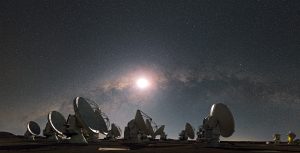
The Moon and the Arc of the Milky Way
