


Dear readers,
Alien Encounters and Extraterrestrial life have always existed in two realms of our imagination: as a profound scientific enigma and as a boundless canvas for our most extravagant tales.
Modern science scans the skies with powerful telescopes and cutting-edge technologies, searching for signs of life. In contrast, science fiction has spent over a century painting the cosmic silence with bold, imaginative visions.
At the same time, our collective curiosity is fuelled by unexplained phenomena, mysterious sightings and government disclosures, creating a fascinating feedback loop between science, science fiction, mysterious sightings and official records, as we shall see in this article.
Close Encounter Types
Dr J. Allen Hynek, a prominent US astrophysicist who served as a scientific advisor to the US Air Force’s UFO studies, categorised human-alien encounters into three primary types, which other researchers later expanded.
Here are the standard Alien Encounter Types:
1. Close Encounters of the First Kind (CE-1): Visual Sighting of a UFO – This involves seeing an unidentified flying object (UFO) within 500 feet (approx. 150 meters) of the witness, but there is no interaction with the environment or the witness. Example: A metallic disc hovers silently over a field, then darts away.
2. Close Encounters of the Second Kind (CE-2): Physical Evidence or Interaction with the Environment
The UFO leaves tangible evidence of its presence or directly affects the surrounding environment. This is considered “hard evidence.” Examples: Burn marks or scorched Earth where the craft hovered. Radiation detected at landing sites. Compressed or rearranged vegetation (crop circles, though some are hoaxes).
3. Close Encounters of the Third Kind (CE-3): Sighting of Occupants.
The witness sees one or more “beings” (humanoid or otherwise) associated with the UFO. There is no direct communication or interaction beyond sight. Example: Witnesses see small, grey figures moving around a landed craft from a distance.
4. Close Encounters of the Fourth Kind (CE-4): Direct Contact or Abduction.
The witness is directly and physically involved with the alien beings. Being taken aboard a craft, undergoing medical-like examinations, or being communicated with telepathically.
What Science Really Knows
Despite decades of searching, there is no confirmed evidence of extraterrestrial life. We have not found fossils, radio signals, or any biological signatures from another world.
However, science has built a strong framework for what to look for and where to look, based on our current understanding and the latest discoveries, including:
- The Copernican Principle: Earth is not a special planet, the elements that make life are among the most abundant in the Universe, and the physical laws are the same everywhere. Therefore, if life arose on Earth under common conditions, it should have arisen countless times across the billions of stars and planets in our galaxy alone.
- Extremophiles on Earth: Life thrives in environments once thought uninhabitable, including deep-sea volcanic vents, highly acidic waters, subglacial lakes, and even radioactive waste. This suggests the habitable zone may be broader than once believed. If so, life could exist on moons such as Europa, with its subsurface ocean, or Titan, with its liquid methane lakes, in forms very different from those on Earth.
- The Search for Biosignatures: Modern astrobiology focuses on finding chemical or physical markers that indicate the presence of life. Researchers look for ‘biosignature gases’—combinations that are hard to explain without life, like oxygen plus
Most scientists think microbial life is likely common in the Universe. Complex, multicellular life is much rarer. Intelligent, technological life may number only a handful per galaxy at any given time. Or we might be it.
Within our solar system, the search is focused on microbes—tiny, single-celled life forms. Scientists study Mars’s ancient lake beds and the subsurface oceans of icy moons such as Jupiter’s Europa and Saturn’s Enceladus, where tidal heating from gravitational forces may provide energy beneath thick ice.
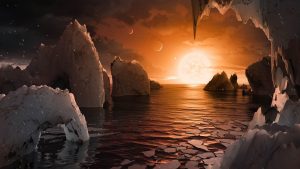
Artist’s rendering of an exoplanet in the TRAPPIST-1 system, situated in the constellation Aquarius, a target of the James Webb Telescope in the search for extraterrestrial life.
Credit: NASA.
The Universe and us.
The Universe stretches across unfathomable distances and ages. Our fascination with UFOs and extraterrestrial life lies at the intersection of our deepest existential wonder, our dreams for a brighter future, our passion for mystery, and our relentless scientific curiosity.
It’s a powerful, almost irresistible combination. Finding even microbial life elsewhere would revolutionise biology, while finding intelligent life would reshape philosophy, religion, and our self-image. It’s the ultimate unknown, and we are hardwired to seek answers to big questions.
The enduring mystery of alien encounters challenges us to distinguish fact from fiction amid speculation and intrigue. Only through ongoing inquiry and critical analysis can we hope to determine our place in the Universe. For now, the question remains unavoidable—and unanswered: Are we truly alone?
Discover in my Female First article here: Alien Encounters: Fact or Fiction?
