


Dear readers,
For centuries, people looked up at the night sky and wondered whether other stars had planets similar to our own. Now we know that the answer is a definite yes.
Scientists have confirmed over 6,000 exoplanets orbiting stars beyond our solar system. Billions more are likely to exist in the Milky Way alone.
The quest to find other worlds like our own has been one of the most exciting scientific endeavours of the last few decades. The discovery of the first exoplanet—a planet orbiting a star other than our Sun—opened the door to a Universe of possibilities.
The first exoplanets to be confirmed were discovered in 1992 by the Polish astronomer Aleksander Wolszczan; they were not found orbiting a star like our Sun but instead circled a pulsar (a rapidly rotating remnant of a star that has exploded) called PSR B1257+12. Their presence was determined by detecting small irregularities in the pulsar’s regular radio pulses, caused by the planets’ gravitational influence.
However, the discovery that truly captured the world’s imagination was the detection of 51 Pegasi b in 1995, 50 light-years away. This breakthrough was so impactful because it revealed a planet orbiting a star very much like our Sun, suggesting that planets could be common around stars similar to our own. It marked a turning point in the search for other worlds and opened the door to the thousands of exoplanet discoveries that followed.
The Rom-Ghenshar World
In The Space Traveller’s Lover, the watery superplanet Rom-Enjie is very different from Earth. Located 70,000 light-years away on the opposite side and below the galactic plane of our Milky Way, Rom-Enjie orbits the binary star system Rom and Ghenshar. Rom is an immense yellow star, and Ghenshar is its smaller red companion. The extended line-up of multi-sized planets poised around the glowing double stars makes it one of the galaxy’s planetary systems. Rom-Enjie, the biggest planet, boasts a multitude of rocky islands surrounded by a multicoloured ocean. Four golden-red moons, locked into a close embrace through a thin, dusty ring, orbit the colourful globe.
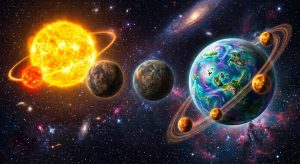
Rom-Enjie in the Rom-Ghenshar planetary system
The Hunt for Distant Worlds
Finding a planet many light-years away is an immense challenge. Planets are tiny and dim compared to their host stars, so astronomers use clever methods to detect them, often by observing their effects on their star.
- The Transit Method: This approach, which accounts for more than 90% of exoplanet discoveries, consists of observing the slight decrease in a star’s brightness when a planet passes in front of it, that is, when a transit occurs. It is a technique of remarkable accuracy, similar to spotting the drop in light from a huge searchlight when an ant crawls across it from a great distance. Missions such as Kepler and TESS have employed this method to find thousands of planets.
- The Radial Velocity, or “Wobble,” Method: This technique was used to discover 51 Pegasi b, the first exoplanet orbiting a Sun-like star. As a planet orbits, its gravity causes its host star to wobble slightly. This wobble creates tiny but detectable shifts in the star’s spectrum. When the star moves toward Earth, its light is shifted slightly toward blue; when it moves away, the light shifts toward red. By measuring these changes, astronomers can tell if a planet is tugging on its star.
- Direct imaging: Although it is extremely difficult, astronomers can now take photographs of some exoplanets. Using devices known as coronagraphs, telescopes can block the intense light of the host star, allowing the planet’s faint light to be captured. The forthcoming Nancy Grace Roman Telescope, with its record-breaking survey speed and sophisticated imaging technology, will transform the study of exoplanets from focusing on individual nearby worlds to conducting a complete census of the galaxy.
Artificial intelligence is also shaping modern astronomy; machine learning algorithms can process the vast amounts of data collected by missions such as Kepler and TESS more efficiently than conventional methods, detecting planetary signals that would otherwise be overlooked.
The Closest Exoplanets: Our Cosmic Neighbours
Some of the most thrilling finds are the exoplanets closest to our solar system, offering us the best chance for close-up exploration.
- Proxima Centaurus b: This is the closest known exoplanet to Earth, orbiting the red dwarf star Proxima Centaurus, a mere 4.2 light-years away in the Centaurus constellation. It is a rocky planet with a mass at least 1.07 times that of Earth and orbits within its star’s habitable zone, the region where liquid water could exist. However, its star emits powerful radiation, which could significantly challenge the planet’s potential habitability by stripping away its atmosphere.
- Barnard b: This recently confirmed exoplanet orbits Barnard’s Star, the closest single red dwarf star to our Sun, located about 6 light-years away in the Ophiuchus constellation. It is a low-mass, rocky world, about half the mass of Venus, that completes an orbit in 3.2 Earth days, indicating it is extremely close to its star. With a surface temperature of around 125°C, it is far too hot to support liquid water and lies well outside the habitable zone.
- Ross 128 b: Orbits an inactive, quiet red dwarf star 11 light-years away in the Virgo constellation. It is the nearest exoplanet considered one of the best candidates for habitability. The exoplanet is only 35% more massive than Earth and is expected to be at a temperature suitable for liquid water to exist on its surface if it has an atmosphere.
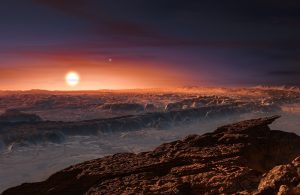
Artist’s impression of the planet orbiting Proxima Centaurus
The Most Earth-Like Contenders
While the closest planets are not necessarily like Earth, astronomers have identified several more distant candidates that share many key characteristics with our world, such as rocky compositions and locations within the habitable zone.
- LHS 1140 b: Located about 49 light-years away in the Cetus constellation. This “super-Earth” (a planet larger than Earth but smaller than Neptune) is considered one of the most promising Earth-like exoplanets ever discovered. Recent observations suggest it has an atmosphere, a crucial ingredient for a stable climate and potential habitability. Its red dwarf host star is also relatively quiet, meaning it doesn’t bombard the planet with as many harmful stellar flares as other red dwarfs.
- TRAPPIST-1 System: This remarkable system, about 40 light-years away, hosts seven Earth-sized planets orbiting a single, cool red dwarf star in the Aquarius constellation. Three of these planets—TRAPPIST-1e, f, and g—orbit within the habitable zone. Their size and mass similarity to Earth make them prime targets in the search for life. However, the proximity to their star raises the possibility they are tidally locked, with one side always facing the star.
- Kepler-186f: The historic first validated Earth-sized planet found inside a habitable zone. It orbits its red dwarf star with a period of 130 days, 580 light-years away in the Cygnus constellation. It is too distant for its atmosphere to be analysed in detail by the most advanced instruments such as the James Webb Space Telescope.
- Kepler-452b: Often called “Earth’s cousin,” this exoplanet orbits a Sun-like star approximately 1,800 light-years away in the Cygnus constellation. It is about 60% larger than Earth and orbits at a similar distance from its star with a period of 385 days. It is the first super-Earth planet discovered orbiting within the habitable zone of a very Sun-like star.
- Kepler-1649c: This Earth-sized exoplanet is located about 301 light-years away, in the Cygnus constellation. It orbits its red dwarf star within the habitable zone, making it a prime candidate for the search for extraterrestrial life.
LHS 1140 b is the leading exoplanet candidate for true habitability — arguably the best we’ve ever found. It stands out because it is not merely “Earth‑like”; it is one of the very few worlds where multiple independent observations point toward a stable atmosphere and a global ocean, both essential for long‑term habitability.
Proxima Centaurus b remains an exciting possibility because it is close (making it the main target for future interstellar missions). However, its severe radiation history means that it is a high-risk candidate when it comes to habitability.
A Universe of Possibilities
The hunt for planets outside our solar system is a story of continuous discovery and ever-advancing technology; from the very first daring detections to the use of AI-powered telescopes, we are moving ever closer to answering that old question: are we alone?
As of late 2025, about 70 known exoplanets meet the formal criterion for potentially harbouring liquid water, a number expected to grow with future missions such as the Nancy Grace Roman Space Telescope, due to launch on August 30, 2026.
The planets mentioned here are the most promising prospects on this cosmic voyage; each a distinct world offering a different insight into what a planet might be and bringing us closer to discovering a true “Earth 2.0”.
Scientists press on in the search for our cosmic twin, seeking to unravel our origins, push the boundaries of human ingenuity, and ultimately answer one of humanity’s oldest questions: is there another sky out there with eyes gazing back at us?
Discover more in my original article: Alien Worlds: Sanctuaries or Wastelands?
