


Dear readers,
Throughout history, the night sky has served as a source of inspiration for human inquiry. Prior to advancements in astronomy and scientific understanding, early civilisations interpreted celestial objects not merely as stars, but as representations of deities, mythical figures, and symbols reflecting their cultural values and beliefs.
From the Hindu cosmic egg and the Olympian Greek gods to the Mayan sacred calendar and the Aboriginal celestial emu, ancient peoples did more than watch the sky. They wove it into their beliefs about life, death, morality, and nature. In the eternal lights above, they saw their own humanity magnified.
The night sky is humanity’s first cinema, our earliest myth-making canvas, and the oldest library of mysteries.
For science fiction writers, it offers a limitless passport for the imagination.
With this rich history in mind, let’s explore how the enigmatic cosmos continues to inspire the stories we create and lead us to new frontiers.
1. The Canvas for Limitless Imagination
Writers gaze skyward and see more than stars. We imagine entire worlds. The universe’s staggering scale suggests that no idea is too bizarre—somewhere in all that vastness, it could exist.
- Alien Worlds: Every star is a potential sun, and every point of light could be a solar system. The variety of exoplanets we now know exists—from scorching hot Jupiters to diamond planets—confirms what sci-fi has long assumed: the universe is filled with places stranger than we can imagine. This allows writers to build civilisations on desert planets (Dune‘s Arrakis) or lush jungle moons (Avatar‘s Pandora).
- Alien Life: The night sky sparks constant questions about the life that might dwell there. Could the unusual infrared emissions from distant stars indicate the alien megastructures known as Dyson spheres? Is it possible that interstellar objects entering our solar system are alien spacecraft cleverly disguised? Such mysteries inspire stories of first contact, from the incomprehensible heptapods in Arrival to the terrifying predator in
- Alien Invasions: The alien invasion is one of the most enduring and versatile concepts in science fiction. It’s a narrative framework that has been used to explore a vast range of human fears, hopes, and social status, evolving dramatically alongside our own history and technology. The nature of the invader defines the story: from Martians trying to eliminate mankind and occupy Earth in The War of the Worlds, to slug-like creatures controlling humanity and turning us against ourselves in The Puppet Masters.
In my debut sci-fi romance, The Space Traveller’s Lover, I tell the story of an unstoppable alien soldier from a distant oceanic world and a brave human woman. They are locked in a battle between love and duty, and their choices will decide the fate of both humanity and the technologically advanced, human-like race determined to reign supreme in our universe.
As I crafted the sci-fi elements of my story, I drew inspiration from real astronomical phenomena as well as the deep emotions we humans feel beneath the stars. I explored how ancient myths shape our visions of alien worlds and wondered how love and loyalty might unfold in a truly alien setting. For us authors, this is a powerful tool: let the cosmos stir your fears, hopes, and questions, then let those emotions breathe life into your plot, your characters, and the worlds they inhabit.
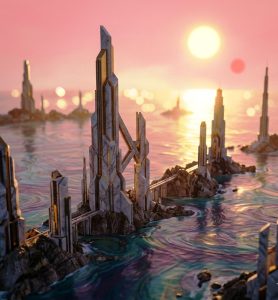
Rom-Enjie, the distant oceanic world as described in The Space Traveller’s Lover.
Ultimately, the night sky stands as the perfect metaphor for the future itself: vast, mysterious, full of danger, but dazzling with the promise of discovery. As we look ahead, science fiction remains the art of building a new world and sailing into it—connecting myth, fear, ambition, and discovery.
2. The Unknowable and Existential Fear
The night sky’s beauty is rivalled only by its vast, chilling emptiness. This haunting duality fuels both conflicting ideas and profound philosophical arguments, most famously:
- The Lovecraftian Horror: American author H.P. Lovecraft masterfully tapped into the fear of the unknown. He took the idea that we could be alone in a meaningless universe and created a new style of science fiction horror. The stars aren’t just distant; they are home to incomprehensible beings (like Cthulhu, from his seminal short story, The Call of Cthulhu for whom humanity is less than an afterthought. The night sky becomes a veil, hiding a terrifying reality that can shatter the human mind.
- The Fermi Paradox: The renowned Italian-American physicist Enrico Fermi famously asked, “If the universe is so big, where is everybody?” as a direct result of contemplating the silent stars. This paradox has spawned countless explanations, including:
- The Dark Forest Theory: This suggests that civilisations hide in silence because revealing their location is akin to suicide in a universe of scarce resources and unknown threats.
- The Zoo Hypothesis: We are deliberately being isolated, either for our protection or as part of a grand experiment akin to a cosmic wildlife reserve.
- The Great Filter: Such silence implies that some inevitable catastrophe wipes out civilisations before they can traverse the stars, begging the question: Will it happen to us?
- The Rare Earth Hypothesis: This argues that complex life is extremely rare. While single-celled life might be common, the specific chain of events that led to humans—from a stable, large moon to plate tectonics to the right position in the galaxy—is a cosmic fluke.
- The Brief Window Hypothesis: Technological civilisations are widespread, but they tend to be short-lived. If the average lifespan of a technological species is only a few thousand years, the chance of two existing simultaneously and being close enough in space to detect each other is astronomically small.
- The Drake’s Equation: Formulated by American astronomer Frank Drake in preparation for the first scientific meeting on the search for extraterrestrial intelligence (SETI). The equation’s purpose was to stimulate dialogue and guide scientific research through quantifying the unknown. It is used to estimate the number of active, communicative extraterrestrial civilisations in the Milky Way galaxy. It is not a precise formula, but rather a systematic way of breaking down a complex question: “Are we alone?” into a series of smaller, more workable steps. The Drake Equation is not about getting a definitive answer. Its real worth lies in directing our analysis on the key factors we need to consider to answer the Fermi Paradox.
The search for extraterrestrial life is currently experiencing a revolutionary transformation. This effort now comprises multiple approaches, integrating advanced analytical methods, next-generation telescopes, and a broader scope of potential targets. For remote exoplanets, direct sample collection is not feasible; therefore, researchers examine atmospheric properties using spectroscopy, which involves studying how starlight passes through planetary atmospheres. The James Webb Space Telescope (JWST), the largest telescope in space, is among the most effective instruments for this purpose, enabling the detection of chemical compositions within the atmospheres of exoplanets.
3. A Source for Scientific Breakthroughs
Science fiction has consistently acted as a significant catalyst for innovation, serving as both a conceptual laboratory and a benchmark for scientific progress. The connection between science fiction and scientific development is mutually beneficial: science fiction offers visions—narratives that depict aspirational or cautionary futures—while inspiring researchers and engineers to pursue practical solutions and set future objectives.
Here are a few compelling examples:
- Geostationary Satellites (Arthur C. Clarke)
- The Sci-Fi Source: A 1945 article in Wireless World magazine titled “Extra-Terrestrial Relays” by Arthur C. Clarke (who also wrote 2001: A Space Odyssey).
- The Breakthrough: Clarke calculated that a satellite in a geostationary orbit (35,786 km above the equator) would orbit the Earth at the same speed as the planet’s rotation, making it appear fixed in the sky. He proposed that a network of three such satellites, spaced 120 degrees apart, could provide global communication. This conceptual blueprint became the basis for all modern satellite communications, including TV broadcasting, GPS, and global internet infrastructure. The orbit itself is now officially known as the “Clarke Orbit.”
- The Helicopter (Jules Verne)
- The Sci-Fi Source: Robur the Conqueror (1886) by Jules Verne. The novel featured a fictional heavier-than-air flying machine called the Albatross, which used multiple rotary wings (rotors) for lift and propulsion.
- The Breakthrough: Verne’s detailed mechanical descriptions of a rotorcraft captured the public imagination. It’s widely believed that his work influenced pioneers such as Igor Sikorsky, who built the first practical, mass-produced helicopter in the 1940s. Verne didn’t invent the helicopter, but he created a compelling cultural and technical vision that helped pave the way for its acceptance and development.
- The Cell Phone (Gene Roddenberry)
- The Sci-Fi Source: Star Trek: The Original Series (1966). The handheld, wireless communicator used by Captain Kirk and crew.
- The Breakthrough: Martin Cooper, a Motorola executive, cited the Star Trek communicator as inspiration for the first handheld mobile phone in 1973. His goal was a phone small enough to fit in a pocket, just like the show’s device.
As we have seen, science often strives to turn yesterday’s fiction into tomorrow’s reality, proving that storytellers’ imagination can be one of the most powerful engines of scientific progress.
At its core, science fiction is fuelled by wonder. Who can look up at a clear, star-strewn sky and not feel awe, humility, and curiosity? Writers chase that feeling, hoping to share it. The night sky brims with potential, promising new energies, new physics, and new ways of being. It reminds us that reality is not fixed, and the future may be unimaginably different.
Why not turn this inspiration into action? On a clear moonless night, lift your eyes to the stars and let your imagination roam free. Scribble down a story idea sparked by what you see or feel as you gaze into the cosmos. Your next tale could begin with a single glimmer in the night sky.
See this article also in Female First Magazine! How the Night Sky Inspires Science Fiction Stories
