


Dear readers,
The January night sky showcases its brightest jewels, inspiring wonder and curiosity in all who look up and admire the winter stars, igniting a sense of awe and connection with the cosmos.
The prominent constellation Orion the Hunter, featuring the bright stars Rigel and Betelgeuse, dominates the southern sky. Above and to the right of Betelgeuse, the fiery orange star Aldebaran marks the eye of Taurus the Bull. Below and to the left of Rigel, the dazzling star Sirius sparkles vibrantly in Canis Major. To the left of Betelgeuse, the bright star Procyon in Canis Minor seems to compete with Sirius for attention. High overhead, Capella in Auriga twinkles like a gem, illuminating the zenith. But that’s not all. Completing this star-studded gathering, Jupiter shines brightly beneath the twin stars Castor and Pollux in Gemini throughout the entire month.
In this article, we will explore the fascinating diversity of bright stars visible during the winter season and the patterns they form, such as the Winter Hexagon and the Winter Triangle. These patterns help make it easier to navigate the night sky and discover new celestial treasures.
This time of year provides some of the clearest and most spectacular stargazing opportunities, especially on clear, cold nights with minimal light pollution. As you gaze at these radiant stars, you can uncover and admire the magnificent celestial objects within, transforming a simple night of stargazing into an exploration of the cosmos.
The Winter Hexagon and the Winter Triangle as they appear in the January night sky
The Winter Hexagon
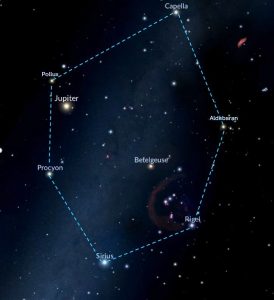
Digital Art of the Winter Hexagon and its distinctive star types and colours
The Winter Hexagon is a prominent asterism (a pattern of stars) formed by six of the brightest stars in the winter sky. Spanning several constellations, it invites you to explore the night sky’s most remarkable features, with Orion the Hunter shining brightly within it.
To visualise the Winter Hexagon on the stellar canvas, look high towards the southwestern sky and locate the bright star Capella. Then connect the dots of the brightest stars in clockwise order as follows:
- Capella – In Auriga (the Charioteer). A quadruple star system of two primary yellow giants and two fainter red dwarfs 43 light-years away. It is the sixth-brightest star in the night sky.
- Aldebaran – In Taurus (the Bull). An orange giant star that, at a distance of only 65 light-years, is one of the nearest giants to our solar system. It is the fourteenth-brightest star in the night sky.
- Rigel – In Orion (the Hunter). A blue superluminous supergiant, 870 light-years away. It is the seventh-brightest star in the night sky.
- Sirius – In Canis Major (the Great Dog). A massive white star just 8.6 light-years away from Earth, one of our nearest stellar neighbours. It is the brightest star in the entire night sky.
- Procyon – In Canis Minor (the Little Dog). A binary system formed by a luminous white star and a much fainter white dwarf, orbiting each other 11.4 light-years away. It is the eighth-brightest star in the night sky.
- Pollux – In Gemini (the Twins). A massive yellow-orange star, 34 light-years away, making it the closest giant star to the Sun. It is the seventeenth-brightest star in the night sky.
The Winter Hexagon serves as your map to the brightest stars and the most remarkable wonders of the winter night sky. It showcases the most brilliant collection of stars observable at any one time of year, covering a large area of the sky.
Together, these six stars not only illuminate the cold winter nights but also offer an extraordinary glimpse into the vast diversity and complexity of stellar types within our galaxy.
Within the hexagon lies a treasure trove of deep-sky wonders visible to the naked eye:
- The Constellation Orion: With its flagship stars Betelgeuse, Rigel, Bellatrix and Saiph.
- The Orion’s Belt: A perfect diagonal alignment of three stars born from the same stellar nursery.
- The Great Orion Nebula (M42): A vast stellar nursery, visible as a fuzzy patch below Orion’s Belt.
- The Winter Triangle: A smaller asterism formed by the brilliant stars Betelgeuse, Procyon and Sirius.
- The Winter Milky Way: Runs through the hexagon, though fainter than the Summer Milky Way.
Furthermore, if you have binoculars or telescopes at your disposal, the Milky Way presents a wealth of open clusters and nebulae that are easy to locate within the Winter Hexagon, with the Rosette Nebula being one of the most renowned.
The Rosette Nebula’s open star cluster (NGC 2244)
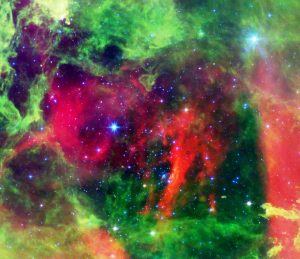
The open cluster NGC 2244 in the Rosette Nebula, taken by NASA’s Spitzer Space Telescope.
The open cluster NGC 2244 in the Rosette Nebula, taken by NASA’s Spitzer Space Telescope.
The Rosette Nebula is a large emission nebula located within the Winter Hexagon and the Winter Triangle, to the left of the red supergiant Betelgeuse. It appears roughly the size of five full moons, but its faint glow makes it challenging to see with the naked eye. Using binoculars or a small telescope under dark skies can reveal the stunning view of its central star cluster NGC 2244.
The nebula is a vast, beautiful stellar nursery where a central cluster of hot, young stars has sculpted the surrounding gas cloud into a cosmic flower, making it one of the most iconic and photogenic objects in our galaxy.
Within the confines of NGC 2244, the massive stars burn brightly but have fleeting lifespans, typically lasting only a few million years. They will eventually end their lives in spectacular supernova explosions, further reshaping the nebula and triggering new waves of star formation in the surrounding material.
Throughout the vast expanse of the cosmos, we are captivated by the perpetual cycle of birth, death, and rebirth. Stars ignite with dazzling brilliance, only to eventually fade or explode into the void, giving rise to new celestial bodies.
This breathtaking dance of existence unfolds endlessly, a testament to nature’s resilience and creativity in an ever-evolving universe.
In collaboration with The European Magazine
