


Dear readers,
In The Space Traveller’s Lover, the fascinating Eridanus constellation is the gateway from Earth to the Rom-Ghenshar world.
Two worlds that will become the battleground for Erin’s heart and soul.
Standing at the epicentre of a catastrophe, every decision Erin makes ripples across the galaxy, impacting the fate of her planet and her people, threatening to consume everything she holds dear. The stakes are incredibly high, and she cannot allow herself a second of respite.
The Universe is vast, but so is her love. What to do? She decides to fight for her values and beliefs with an inner strength that leaves even the most powerful soldier speechless.
Eridanus and The Space Traveller’s Lover
In chapter 16, “The Visitor”, she admires the night sky while peering at her distant world:
Out in the open, she saunters through the fields with her arms fully
open while her gleeful eyes stay fixed on the starry sky. “So far and yet so
close,” she says to herself as she glances through the constellations, taking
her time to admire the glittering starlit night. She watches the prominent
Orion stars shining over the horizon, then focuses on the less conspicuous
Eridani system, waving its dim pearly wreath right off the bright star Rigel.
She watches each faint point of light on its wavy river-like pattern, feeling
as if her ancestral home is calling on her, and she is responding. All the
while, she cannot stop thinking about Rothwen
And in chapter 23, “The Day of The First Meeting”, she explains:
“The Rom-Ghenshar system, in the direction of the Eridani
constellation from your location—seventy thousand light-years away,
below the galactic plane, on the other side.” She amplifies the image even
further, revealing the majestic binary system of an immense yellow star and
its smaller red companion, bound in an oblique orbital path. The extended
line-up of multi-sized planets poised around the glowing double stars soon
appears in the unfolding view. Zooming in further, the image veers off
and focuses on a colourful globe, accompanied by four golden-red moons
locked into a close embrace through a thin, dusty ring.
“And this is our mother planet!” she proudly announces.
As we gaze at the southern winter sky, marvelling at the sweeping arc of the Milky Way and the bright constellations of Orion and Taurus, now is the perfect time to uncover some of the night sky’s hidden gems in a region of the sky known as “The Water”. By delving into the fainter constellation of Eridanus the River, we can discover intriguing celestial wonders like the mysterious dwarf star Epsilon Eridani, with a solar system similar to our own and a lurking exoplanet.

The extrasolar planet and asteroid belts in Epsilon Eridani.
Artist Impression from NASA-JPL-Caltech
Find Beta Eridani (Cursa) and Epsilon Eridani (Ran) in Eridanus
To the right and below of Rigel, the brightest star in Orion the Hunter, lies the fainter yet extensive constellation of Eridanus the River. It is the sixth-largest constellation in the night sky, appearing like a pearly winding river across the southwestern sky.
The most prominent star in Eridanus, and the ninth brightest star overall in the night sky, is the blue giant Achernar, part of a binary system. This shining star marks the end of the River, but sadly, it is not visible from northern latitudes. However, other remarkable stars within Eridanus, such as Cursa (Beta Eridani) and Ran (Epsilon Eridani), rise above the horizon, inviting us to explore this fascinating celestial River.
Beta Eridani, commonly known as Cursa, is a blue-white giant star 25 times more luminous than our Sun and located 89 light-years away. You can find it to the right and above the bright star Rigel, near the foot of Orion the Hunter. The name “Cursa” means “the footstool.” It is the second brightest star in the Eridanus constellation.
Continuing along the River Eridanus and down its elongated slope, we find the famous star Epsilon Eridani, also known as Ran. This orange dwarf star is believed to host at least one Jupiter-like planet. Surrounded by swirling dust disks and asteroid belts, Epsilon Eridani offers astronomers a unique opportunity to study a planetary system like our own Solar System. At only 10.5 light-years away, Epsilon Eridani is the third-closest star visible to the naked eye, after Alpha Centauri and Sirius.
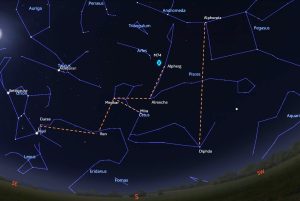
The November Night Sky. Looking South
Find out more about the November Night sky in my latest feature on The European Magazine: November Night Sky Events: Supermoons, Shooting Stars, and Celestial Wonders
