


Dear readers,
In The Space Traveller’s Lover, the beautiful Orion constellation features prominently as one of Erin’s favourite sights in the night sky.
In chapter 16, The Visitor, it reads:
Shaillah closes the heavy cell door and races down the stairs like a
fleeting ghost. She exits the outside gates, passing in front of the night
guard, who sips unwittingly at his cup of coffee.
Out in the open, she saunters through the fields with her arms fully
open while her gleeful eyes stay fixed on the starry sky. “So far and yet so
close,” she says to herself as she glances through the constellations, taking
her time to admire the glittering starlit night. She watches the prominent
Orion stars shining over the horizon, then focuses on the less conspicuous
Eridani system, waving its dim pearly wreath right off the bright star Rigel.
She watches each faint point of light on its wavy river-like pattern, feeling
as if her ancestral home is calling on her, and she is responding. All the
while, she cannot stop thinking about Rothwen.
The approaching scouting-craft interrupts her thoughts. As the craft
smoothly brakes to a halt and silently hovers by her side, she swiftly boards
it, flying through the opening top cabin.
The October Night Sky
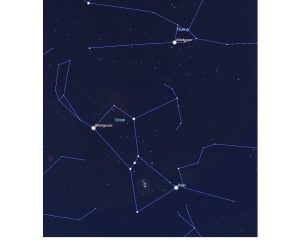
In the eastern sky, Capella shines brightly in the Auriga constellation, to the left of the Pleiades star cluster and orange Aldebaran in the Taurus constellation. Right below, Orion the Hunter is rising with its striking and unique arrangement of bright stars, a sight that never fails to pique our curiosity and remind us that winter is approaching.
Known for its distinctive shape resembling a hunter, Orion is positioned along the celestial equator, an imaginary line in the sky that mirrors the Earth’s equator, making it visible from nearly every corner of the Earth.
Orion boasts a stunning collection of bright celestial objects, including the iconic stars Betelgeuse and Rigel, and the famous Great Orion Nebula, a spectacular stellar nursery where new stars are formed.
In this article, we delve into the fascinating features of Orion, exploring the characteristics of its main stars and nebulae, as well as its intriguing mythology.
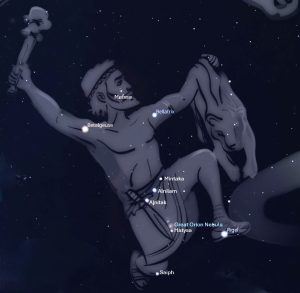
Constellation Art of Orion the Hunter and its main stars
The Orion’s Belt
The most well-known asterism in the Orion constellation is Orion’s Belt. This prominent feature is formed by three bright stars: Alnitak, Alnilam, and Mintaka. These stars are arranged in a nearly straight diagonal line and have similar brightness and distances from each other, making them easy to identify in the night sky.
The stars of Orion’s Belt are not just a random line-up in the sky. They are siblings, born from the same cosmic nursery, at roughly the same time. All three are spectacular, massive, luminous stars:
- Alnitak: The westernmost star, located 1,260 light-years away. It’s a triple star system where the primary component is a blue supergiant about 20 times the mass of the Sun.
- Alnilam: The belt’s central star and one of the most luminous stars known. It is a blue supergiant about 40 times the mass of the Sun, located 1,340 light-years away.
- Mintaka: The easternmost star, located 1,200 light-years away. It is a unique quintuple star system where the primary component is itself a triple system of massive stars.
It’s been suggested that the pyramids of Giza in Egypt and the pyramids of Teotihuacan in Mexico are aligned with the stars of Orion’s Belt. This alignment holds profound historical and cultural significance for these astronomical bodies, influencing ancient architecture and connecting us to the wisdom and beliefs of our ancestors in a profound way.
The Great Orion Nebula
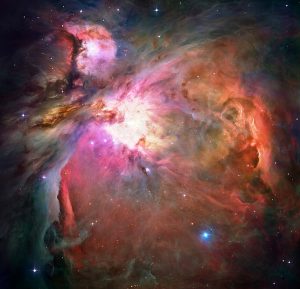
The Great Orion Nebula as imaged by the Hubble Space Telescope.
Below Orion’s belt, there is another prominent asterism known as Orion’s Sword. It consists of several bright stars, clusters and most notably the Great Orion Nebula.
The brightest star in Orion’s Sword is Hatysa, a multiple-star system member of the star cluster known as “The Lost Jewel of Orion”. Just above Hatysa and appearing as the central star of the Sword asterism, you can find one of the brightest nebulae visible to the naked eye and the closest region of massive star formation to Earth: The Great Orion Nebula.
This magnificent nebula is not just a stunning sight in the Orion constellation; within its swirling clouds of gas and dust, new stars are born, offering us a front-row seat to the fascinating process of star formation. Additionally, it is home to several star clusters, including the Trapezium Cluster, which consists of very hot, young stars casting their intense glow on the surrounding cloud walls.
Because of its brightness, proximity, and status as an active star-forming region, the Great Orion Nebula is one of the most intensively studied celestial objects.
Rigel
Rigel, a prominent star marking the left foot of the constellation Orion the Hunter, is a multiple-star system situated approximately 860 light-years from Earth. Rigel ranks as the seventh brightest star in our night sky, making it a significant point of reference in celestial navigation and a prominent figure in various mythologies.
At the heart of this four-star system lies Rigel A, an impressive white-blue supergiant. Rigel A is considerably more massive than our Sun, with an estimated mass around 20 times greater, and it radiates a luminosity that surpasses that of thousands of Suns.
Close to Rigel lies the faint reflection nebula known as the Witch Head Nebula, characterised by its distinctive shape, featuring a long nose and a pointed chin. The walls of the nebula shine with light reflected from Rigel, creating a stunning display that showcases the cosmos’ unique beauty.
Betelgeuse
Betelgeuse is a spectacular red supergiant star glowing on the right shoulder of Orion the Hunter and is the tenth brightest star in the night sky. Located approximately 600 light-years away, Betelgeuse is one of the largest stars visible to the naked eye, with a radius estimated to be over 700 times that of the Sun. If placed at the centre of our solar system, its surface would extend beyond the asteroid belt, engulfing the orbits of Mercury, Venus, Earth, Mars, and even Jupiter. As recently as 2024, astronomers confirmed the existence of a much smaller star orbiting very close to Betelgeuse, which was named Siwarha.
Betelgeuse is in the late stages of its life due to its massive size and rapid evolution. It is expected to end its life in a supernova explosion, which will be visible even during daylight and may shine as brightly as a half-Moon for several months. In late 2019, Betelgeuse experienced a significant dimming event, known as “The Great Dimming”. During this event, its brightness dropped by about 60%, due to the star ejecting its outer layers and creating a dust cloud that partially obscured it.
Bellatrix
Bellatrix, located on the left shoulder of Orion, is a massive blue giant star. It has a luminosity thousands of times greater than that of the Sun and is relatively young in astronomical terms. Situated approximately 250 light-years away from Earth, Bellatrix is the 26th brightest star in the night sky and the third brightest in the constellation of Orion, following Rigel and Betelgeuse.
Among the bright stars in the constellation Orion, Bellatrix stands out as the first to appear in the eastern sky around midnight in October. As the hours go by, this striking star ascends higher, revealing the magnificent Orion constellation in all its splendour.
Surrounding Bellatrix is a faint nebulosity illuminated by the bright star aptly named the Bellatrix nebula. The interstellar dust in this nebula reflects the intense, brilliant white-blue light of Bellatrix, giving it a similar blue hue.
Saiph
Saiph is an extremely hot blue supergiant marking the right knee of Orion the Hunter. It is approximately 650 light-years away from us, making it closer than Rigel, although it appears less luminous in the visible spectrum because of its intense ultraviolet radiation.
Saiph is 60,000 times as luminous as our Sun, and approximately thirty times as massive. Rapidly losing its stellar mass as its outer layers are expelled into space, this enormous star is expected to end its life in a dramatic stellar explosion known as a supernova.
Meissa
Meissa is a fascinating multiple-star system marking the head of Orion the Hunter, known for its luminosity, surrounding nebulosity, and role as the central star of the Lambda Orionis star cluster.
Located over 1,100 light-years away, Meissa serves as the apex of a triangle formed by Betelgeuse and Bellatrix. Surrounding this massive blue giant star is a large ring of nebulosity thought to be the remnant of a supernova explosion and known as the Lambda Orionis Ring.
Mythology
Orion is one of the oldest recognised constellations, with references found in ancient Greek, Babylonian, Aboriginal and Egyptian cultures.
In Greek mythology, Orion was a giant, supernaturally strong hunter. The constellation depicts him with a club and shield raised against Taurus the Bull. One myth tells of his boast that he would kill every animal on Earth, prompting the gods to send a scorpion to kill him. Having recovered from the scorpion’s sting, he realised how precious life is and repented of his boast. Then the gods placed him in the heavens on the opposite side of the scorpion, allowing Orion to hide as Scorpius rises.
In summary, Orion is a prominent and legendary constellation home to some of the sky’s most spectacular sights. From dying supergiants to the glowing nurseries where new stars are born, Orion is a captivating subject for both stargazers and astronomers alike.
