


In The Space Traveller’s Lover, Rothwen is preparing to lead his Invincible Grand Fleet on a takeover mission to Omega Centauri, the last unconquered enclave of the Milky Way for the Rom-Ghenshar, making this his most challenging mission yet.
As Rothwen departs in his flagship, The Prestige, he is confident of victory despite the significant dangers that lie ahead. The themes of his journey and the challenges he faces alongside Shaillah are central to the second volume of The Space Traveller’s Lover.
Let’s eagerly anticipate Rothwen’s adventures as we embark on an imaginative journey to Omega Centauri in this article.
The Milky Way’s biggest globular cluster: Omega Centauri
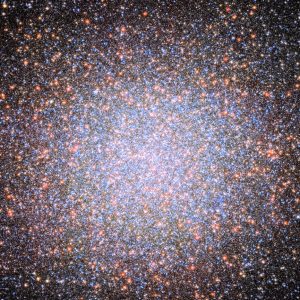
Omega Centauri – By NASA’s Hubble Space Telescope
Omega Centauri, a breathtaking globular star cluster, is a colossal structure located more than 17,000 light-years away in one of our Milky Way Galaxy’s inner arms, the Norma Arm.
This awe-inspiring star gathering, the most massive globular cluster known, is home to millions of multicoloured stars densely packed within a region approximately 150 light-years in diameter. Its sheer size and grandeur, a spectacle of celestial beauty, have captivated astronomers and stargazers alike.
Visible to the naked eye from dark skies, the cluster appears larger yet fainter than the full Moon. It is the largest and brightest globular cluster in the night sky, making it one of the favourite celestial objects for stargazers in the southern hemisphere.
In the centre of this magnificent cluster, the stars are spaced so closely together that, on average, they are only 0.1 light-years apart. To put this into perspective, this distance is similar to having our closest star, Proxima Centauri, located within the Oort Cloud of our solar system, which is a region of space at the outer edges of our Sun’s gravitational influence.
Omega Centauri is home to ancient stars that are billions of years old—older than our 4.6-billion-year-old Sun. Amidst these celestial giants are other stars of various ages and compositions, creating a stunning tapestry of stellar evolution. This rich diversity of stellar populations hints at a complex galactic origin and dynamic processes shaping this remarkable aggregation of stars over aeons.
If you were to approach Omega Centauri’s core, the sky would be so filled with stars that night would look like day. These stars are racing, especially at the centre of the cluster, hinting at the presence of a supermassive black hole or clusters of neutron stars.
The breathtaking beauty and complexity of Omega Centauri serve as a powerful reminder of the vastness and richness of our universe, inspiring us to wonder: What if we could embark on a journey to Omega Centauri? Imagine traversing the sea of stars, discovering celestial wonders at every turn, and ultimately stopping at a safe distance from the event horizon of its black hole.
We can begin our journey by exploring some fantastic sightseeing treasures as we depart from our home planet. First, we will visit the red supergiant star Antares. Next, we’ll explore the Globular Cluster NGC 6397, followed by the incredible Eta Carina Nebula (NGC 3372) and the glittering star cluster Kappa Crucis (NGC 4755). Finally, we will speed towards Omega Centauri, the extraordinary globular cluster that beckons with its myriads of stars, all glistening like jewels against the cosmic expanse.
The dazzling red supergiant star Antares A
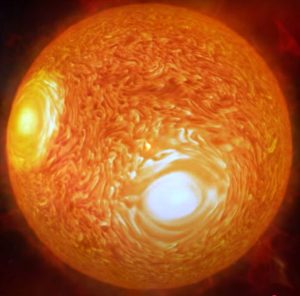
A close-up of the red supergiant star Antares A
As we approach the red glowing Antares, we discover that it is a two-star system with contrasting properties. The second star, known as Antares B, is a blue-white main-sequence star that is more massive than our Sun but smaller than Antares A. Together, these stars follow an almost circular orbit as they travel through space. Occasionally, we can observe coronal mass ejections from the red supergiant Antares A, massive bursts of solar wind, plasma, and magnetic fields, impacting the atmosphere of its smaller companion.
Antares A is truly gigantic, approximately 700 times the sun’s diameter, and more than 10,000 times brighter.
The Sparkling Globular Cluster NGC 6397
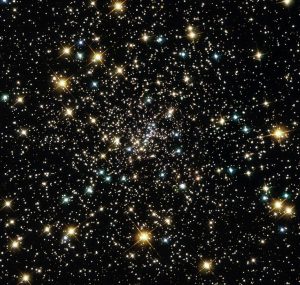
Globular Cluster NGC 6397 – By NASA’s Hubble Space Telescope
Beneath the vibrant glow of Antares, we glide under the sweeping tail of the Scorpion constellation, venturing south of the celestial equator.
Our attention is drawn to a compact, fuzzy ball of shimmering sapphires and glittering gold. As we approach, this ball unfolds into thousands of stars, each one a dazzling gem in a spectrum of vivid blues, fiery reds, and warm yellows. They radiate outward from a dense, luminous core, creating a stunning tapestry of light.
Now, we find ourselves 7,800 light-years away from Earth, visiting one of the closest globular clusters to our planet.
As we observe the swift, swirling movements of these stars around the dense core, we suspect that deep at the heart of this celestial dance lies something far more massive—perhaps the remnants of multiple neutron stars or the enigmatic presence of a black hole.
The Spectacular Eta Carina Nebula (NGC 3372)
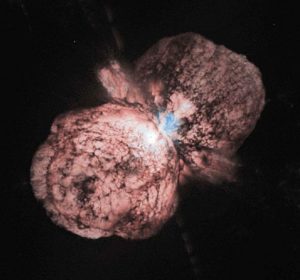
Eta Carina NGC 3372 – By NASA’s Hubble Space Telescope
Leaving the glowing NGC 6397 cluster behind, we set our course for our next destination: the fabulously mysterious Eta Carina Nebula, drawing us to explore the depths of its complex, star-forming regions.
As we journey into the Carina-Sagittarius arm of our Milky Way, situated 8,500 light-years from Earth, we are immediately captivated by the sight of enormous, dusty lobules radiating from a bright central point.
This expanding superstructure seems to be on the brink of self-destruction at any moment, due to the explosive interactions and stellar outbursts from the binary star system at its core. Composed of a dazzling hypergiant and a smaller, yet highly active companion, these stars produce a combined luminosity that surpasses five million times that of our Sun.
Eta Carinae is estimated to be about 100 times more massive than the Sun, making it one of the most massive stars in our Galaxy.
We cannot help but be in awe of the variety and richness of stellar objects in this region. It features clusters of stars harbouring young, highly active stars and intricately shaped dust-gas pillars, offering a unique insight into the complex interaction of matter in the cosmos.
The Jewel Box Kappa Crucis star cluster (NGC 4755)
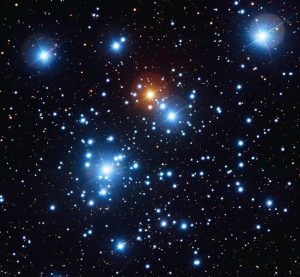
Kappa Crucis – By ESO Very Large Telescope (VLT)
Leaving the mesmerising cosmic landscape of Eta Carina behind, we shift our focus to the edge of the Crux Arm of our Milky Way, located 6,500 light-years away. Here, we can witness the stunning beauty of the Kappa Crucis open star cluster, also known as The Jewel Box.
The vibrant and colourful cluster is home to hundreds of stars of various types, including hot blue and red supergiants, binary systems, and variable stars.
The picturesque scene resembles a cascade of precious gemstones—diamonds and sapphires—spilt across the vastness of space, with a stunning ruby at its centre. This brilliant ruby-red supergiant stands out distinctly against the blue supergiant stars that surround it, creating a uniquely contrasting celestial spectacle.
The colossal globular cluster Omega Centauri
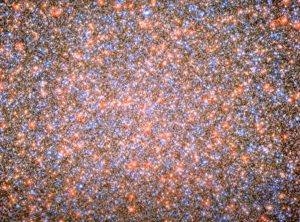
An endless sea of stars in Omega Centauri
We are now preparing to cross the swirling inner arms within the vast expanse of our Milky Way galaxy, the Crux and Norma arms. As we navigate toward the luminous centre of our galaxy, we turn our attention to the largest globular cluster known to humanity—a colossal celestial gathering shimmering with millions of stars.
This compact and diverse collection of stars, located 17,000 light-years from Earth, promises to reveal the great diversity of our universe as we approach its edge. Each brilliant point of light draws our attention, overwhelming us with its beauty and colour.
We observe red giants shedding their vast coronas into the stellar medium while golden-yellow stars shine with a warm brilliance. Hot, blue young stars often erupt with dazzling, highly energised jets of plasma, outshining the more modest red dwarfs, whose faint glow quietly blends into the all-encompassing light mesh.
As we glide through the expanse of this superdense cluster, our senses are overwhelmed by the radiant glow of countless suns. The vivid luminosity dances before our eyes, while intense, highly energised jets shoot through like cosmic fireworks. This light display is the most sensational we have ever witnessed, and it only becomes more dazzling as we move deeper into this stellar wonderland.
The radiant backdrop of intense light surrounds us like a magnificent wall of brilliance, dotted with countless star-like points. Each shimmering star streaks through the dense, luminous medium, gaining speed as we approach the pulsating core. Here, the concentrated stellar energy seems to coalesce into a vibrant, bubbling fireball, creating an overpowering burst of light and power.
However, advancing any further may lead us perilously close to the immense gravitational pull of the colossal black hole, lurking ominously beyond the blinding curtain of radiant light. This celestial giant possesses the power to trap and consume any matter that approaches within its formidable grasp, a relentless force that embodies both the beauty and peril of this otherworldly realm.
As we move away from danger, we catch a glimpse of a breathtaking quadruple-star system, where each star orbits the others at ever-increasing speeds while eclipsing one another’s bright light. In this complex dance of celestial bodies, each star orbits the others with astonishing velocity, its brilliant light occasionally eclipsing the others in a spectacular dance of shadows and bright illumination.
At the heart of this dazzling vortex, a jet of pure energy erupts in both directions, piercing through the surrounding hot plasma with unfathomable force. The jet’s intense brightness creates a stark contrast against the swirling, turbulent gases, illuminating the region in a surreal white glow.
As we hurriedly retreat into the less dense areas of the star cluster, we reflect on the cosmic mechanics at play. The extraordinary interaction of this complex star system must be the result of neutron stars at the core, whose immense gravitational pull and rapid rotation generate this awe-inspiring burst of energy and power.
We are leaving Omega Centauri with a profound sense of humility. We contemplate the vast wonders and mysteries of the universe, from the shimmering expanse of countless stars to the intricate interactions of physical forces that shape the fabric of reality, revealing a complexity that sparks our curiosity.
It is this insatiable desire to uncover the cosmos’ secrets that drives us forward; with each revelation, the universe grows ever more enchanting, beckoning us to delve deeper into its mysteries.
