banner-1
Book - The Space Traveller’s Lover

If you could travel to any star with your lover, where would you go?

Dear readers,

If you could travel to any galaxy with your lover, where would you go?

After reading The Space Traveller’s Lover and immersing yourself in the otherworldly landscapes of distant alien worlds, teeming with vibrant colours and enchanting flora, you feel the Universe at your fingertips. The thrill of survival battles ignites your imagination, inviting you to envision the heart of impossible choices that shape destinies.

The Rom-Ghenshar’s Grand Fleet.

Now, picture yourself aboard The Prestige, the majestic flagship mothership of the Rom-Ghenshar’s Grand Fleet. Under the command of the formidable Rothwen, the most powerful alien soldier our galaxy has ever known, you feel an electrifying sense of adventure. As you stand on the viewing deck, gazing out at the stunning formation of countless shimmering spaceships, each glinting like stars against the backdrop of the cosmos, a sense of wonder fills the air.

Here is an excerpt of Chapter 30, describing the arrival of the Rom-Ghenshar’s Grand Fleet to our Solar System:

Like a perfectly choreographed squadron of giant incandescent
rockets, the Rom-Ghenshars’ Invincible Grand Fleet suddenly emerges at
the outskirts of the extended ring of iced rocky objects surrounding the
solar system, the Oort Cloud. In a seamlessly synchronised manoeuvre,
the milliards-strong mothership fleet spreads out into a vast semicircular
formation. Their fuselage rings blaze in an intense blue glow as they widen
and swivel until they lock into position. Expanding over ten astronomical
units wide and five units deep, the swarming mothership fleet seems
bound to infiltrate the solar system’s defenceless outer domains.

With the vast Universe spread out before you, one tantalising question dances in your mind: Which celestial jewel will you explore next? Will it be a planet shrouded in ethereal dust clouds, a dazzling star cluster, or an enigmatic moon whispering secrets of ancient civilisations? The possibilities are endless, and your journey has only just begun.

The Milky Way

In front of you, the Milky Way unfolds like a shimmering, misty river, its soft, velvety glow inviting you to embark on a journey into the breathtaking vastness of the Universe. This celestial highway is adorned with a dazzling tapestry of star clusters and vibrant nebulae, each harbouring its own unique tale, woven into the fabric of the cosmos.
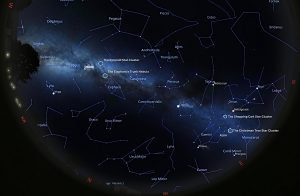
The December Night Sky - Across the Milky Way

The December Night Sky – Across the Milky Way

The remarkable diversity of celestial objects within our galaxy can make it challenging to select just a few to explore. Fear not, for I have curated a selection of stunning celestial treasures for your enjoyment.

As we embrace the warmth and joy of this festive season, let us pause to admire two extraordinary celestial formations that resonate deeply with the spirit of Christmas: the radiant Shopping Cart and the enchanting Christmas Tree star clusters. These captivating wonders illuminate the night sky, twinkling with brilliance and casting an enchanting spell over the holiday landscape.

But let’s start our journey in the west with the beautiful open star cluster M39, also known as the Pyramid Cluster. This cluster features a scattering of youthful blue-white stars, nestled together like a cluster of diamonds adorning the night.

The Pyramid Cluster (M39) in Cygnus.
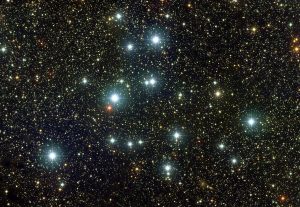
Composite image of the Pyramid Star Cluster (M39), taken using the WIYN telescope at Kitt Peak in Arizona, USA.

Composite image of the Pyramid Star Cluster (M39), taken using the WIYN telescope at Kitt Peak in Arizona, USA.

The Elephant Trunk’s Nebula (IC 1396 A) in Cepheus.

As we make our way eastward, we encounter IC 1396 A, the Elephant’s Trunk Nebula, a magnificent, elongated globule of colourful interstellar gas and dust where hot, cerulean stars are forming in a stellar nursery, cradled within a radiant emission nebula.
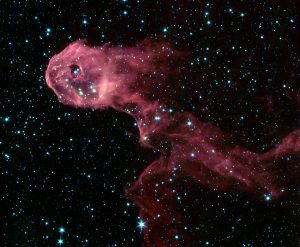
Infrared image taken by NASA’s Spitzer Space Telescope, revealing the glowing stellar nursery embedded within the Elephant's Trunk Nebula (IC 1396 A)

Infrared image taken by NASA’s Spitzer Space Telescope, revealing the glowing stellar nursery embedded within the Elephant’s Trunk Nebula (IC 1396 A)

The Shopping Cart star cluster (NGC 2169) in Orion.

Continuing our exploration, we come across the striking NGC 2169, the Shopping Cart cluster, whimsically named for its distinctive shape reminiscent of a cart—often referred to as the “37” cluster.
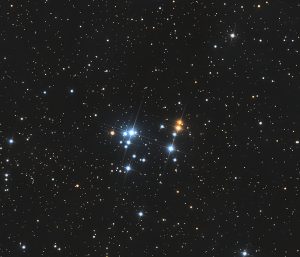
The Shopping Cart star cluster (NGC 2169) in Orion, captured by amateur astronomer Chuck Ayoub.

The Shopping Cart star cluster (NGC 2169) in Orion, captured by amateur astronomer Chuck Ayoub.

 The Christmas Tree star cluster (NGC 2264) in Monoceros.

Finally, we arrive at the remarkable NGC 2264, the Christmas Tree cluster. Here, swirling clouds of interstellar dust envelop an active region of star formation, sculpting a triangular shape that glows with a mesmerising palette of colours, creating a celestial ornament that truly embodies the spirit of the season.
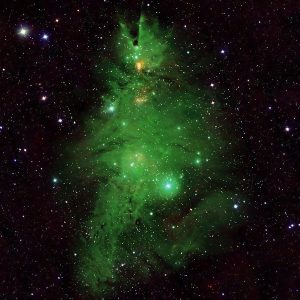
Composite image of the Christmas Tree Cluster, taken by NASA’s Chandra X-ray Observatory.

Composite image of the Christmas Tree Cluster, taken by NASA’s Chandra X-ray Observatory.

Regardless of which destination you choose to explore, the journey through this awe-inspiring galaxy promises to be a spellbinding adventure, filled with admiration for the Universe’s breathtaking treasures.

You can learn more about our Milky Way’s breathtaking starry display in my latest article on The European Magazine: December Night Sky Guide – What to See This Month

Take a moment to step outside and marvel at this magnificent sight and dare to dream …!

Omara Williams

Eridanus and The Space Traveller’s Lover

Dear readers,

In The Space Traveller’s Lover, the fascinating Eridanus constellation is the gateway from Earth to the Rom-Ghenshar world.

Two worlds that will become the battleground for Erin’s heart and soul.

Standing at the epicentre of a catastrophe, every decision Erin makes ripples across the galaxy, impacting the fate of her planet and her people, threatening to consume everything she holds dear. The stakes are incredibly high, and she cannot allow herself a second of respite.

The Universe is vast, but so is her love. What to do? She decides to fight for her values and beliefs with an inner strength that leaves even the most powerful soldier speechless.

Eridanus and The Space Traveller’s Lover

In chapter 16, “The Visitor”, she admires the night sky while peering at her distant world:

Out in the open, she saunters through the fields with her arms fully
open while her gleeful eyes stay fixed on the starry sky. “So far and yet so
close,” she says to herself as she glances through the constellations, taking
her time to admire the glittering starlit night. She watches the prominent
Orion stars shining over the horizon, then focuses on the less conspicuous
Eridani system, waving its dim pearly wreath right off the bright star Rigel.
She watches each faint point of light on its wavy river-like pattern, feeling
as if her ancestral home is calling on her, and she is responding. All the
while, she cannot stop thinking about Rothwen

And in chapter 23, “The Day of The First Meeting”, she explains:

“The Rom-Ghenshar system, in the direction of the Eridani
constellation from your location—seventy thousand light-years away,
below the galactic plane, on the other side.” She amplifies the image even
further, revealing the majestic binary system of an immense yellow star and
its smaller red companion, bound in an oblique orbital path. The extended
line-up of multi-sized planets poised around the glowing double stars soon
appears in the unfolding view. Zooming in further, the image veers off
and focuses on a colourful globe, accompanied by four golden-red moons
locked into a close embrace through a thin, dusty ring.
“And this is our mother planet!” she proudly announces.

As we gaze at the southern winter sky, marvelling at the sweeping arc of the Milky Way and the bright constellations of Orion and Taurus, now is the perfect time to uncover some of the night sky’s hidden gems in a region of the sky known as “The Water”. By delving into the fainter constellation of Eridanus the River, we can discover intriguing celestial wonders like the mysterious dwarf star Epsilon Eridani, with a solar system similar to our own and a lurking exoplanet.

The extrasolar planet and asteroid belts in Epsilon Eridani. Artist Impression from NASA-JPL-Caltech

The extrasolar planet and asteroid belts in Epsilon Eridani.
Artist Impression from NASA-JPL-Caltech

Find Beta Eridani (Cursa) and Epsilon Eridani (Ran) in Eridanus

To the right and below of Rigel, the brightest star in Orion the Hunter, lies the fainter yet extensive constellation of Eridanus the River. It is the sixth-largest constellation in the night sky, appearing like a pearly winding river across the southwestern sky.

The most prominent star in Eridanus, and the ninth brightest star overall in the night sky, is the blue giant Achernar, part of a binary system. This shining star marks the end of the River, but sadly, it is not visible from northern latitudes. However, other remarkable stars within Eridanus, such as Cursa (Beta Eridani) and Ran (Epsilon Eridani), rise above the horizon, inviting us to explore this fascinating celestial River.

Beta Eridani, commonly known as Cursa, is a blue-white giant star 25 times more luminous than our Sun and located 89 light-years away. You can find it to the right and above the bright star Rigel, near the foot of Orion the Hunter. The name “Cursa” means “the footstool.” It is the second brightest star in the Eridanus constellation.

Continuing along the River Eridanus and down its elongated slope, we find the famous star Epsilon Eridani, also known as Ran. This orange dwarf star is believed to host at least one Jupiter-like planet. Surrounded by swirling dust disks and asteroid belts, Epsilon Eridani offers astronomers a unique opportunity to study a planetary system like our own Solar System. At only 10.5 light-years away, Epsilon Eridani is the third-closest star visible to the naked eye, after Alpha Centauri and Sirius.

The November Night Sky. Looking South

The November Night Sky. Looking South

Find out more about the November Night sky in my latest feature on The European Magazine: November Night Sky Events: Supermoons, Shooting Stars, and Celestial Wonders

The Space Traveller’s Lover | Omara Williams

Orion and The Space Traveller’s Lover

Dear readers,

In The Space Traveller’s Lover, the beautiful Orion constellation features prominently as one of Erin’s favourite sights in the night sky.

In chapter 16, The Visitor, it reads:

Shaillah closes the heavy cell door and races down the stairs like a
fleeting ghost. She exits the outside gates, passing in front of the night
guard, who sips unwittingly at his cup of coffee.

Out in the open, she saunters through the fields with her arms fully
open while her gleeful eyes stay fixed on the starry sky. “So far and yet so
close,” she says to herself as she glances through the constellations, taking
her time to admire the glittering starlit night. She watches the prominent
Orion stars shining over the horizon, then focuses on the less conspicuous
Eridani system, waving its dim pearly wreath right off the bright star Rigel.
She watches each faint point of light on its wavy river-like pattern, feeling
as if her ancestral home is calling on her, and she is responding. All the
while, she cannot stop thinking about Rothwen.
The approaching scouting-craft interrupts her thoughts. As the craft
smoothly brakes to a halt and silently hovers by her side, she swiftly boards
it, flying through the opening top cabin.

In the October night sky, Orion the Hunter is rising in the east. This beautiful constellation, with its striking arrangement of bright stars, is a sight that never fails to captivate and remind us that winter is approaching.
Discover more in my latest article for The European magazine here:

The October Night Sky

The Orion Constellation
As we approach the end of Daylight-Saving Time in October, the night sky becomes a canvas of celestial wonders. With each passing day, the nights grow longer, inviting us to step outside earlier, wrapped in warmer clothes, to marvel at the beauty of the night sky.
In the northern sky, Ursa Major is low on the horizon, while the constellations of Cepheus and Cassiopeia are high overhead, flanking the fuzzy ribbon of the Milky Way. The Summer Triangle remains visible, although Altair, part of the Aquila constellation, is nearing the horizon in the west.

In the eastern sky, Capella shines brightly in the Auriga constellation, to the left of the Pleiades star cluster and orange Aldebaran in the Taurus constellation. Right below, Orion the Hunter is rising with its striking and unique arrangement of bright stars, a sight that never fails to pique our curiosity and remind us that winter is approaching.

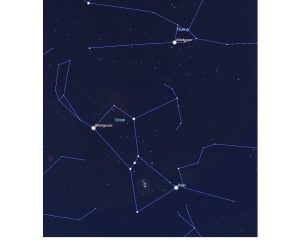
Known for its distinctive shape resembling a hunter, Orion is positioned along the celestial equator, an imaginary line in the sky that mirrors the Earth’s equator, making it visible from nearly every corner of the Earth.

Orion boasts a stunning collection of bright celestial objects, including the iconic stars Betelgeuse and Rigel, and the famous Great Orion Nebula, a spectacular stellar nursery where new stars are formed.

In this article, we delve into the fascinating features of Orion, exploring the characteristics of its main stars and nebulae, as well as its intriguing mythology.

Constellation Art of Orion the Hunter and its main stars

The Orion’s Belt

The most well-known asterism in the Orion constellation is Orion’s Belt. This prominent feature is formed by three bright stars: Alnitak, Alnilam, and Mintaka. These stars are arranged in a nearly straight diagonal line and have similar brightness and distances from each other, making them easy to identify in the night sky.

The stars of Orion’s Belt are not just a random line-up in the sky. They are siblings, born from the same cosmic nursery, at roughly the same time. All three are spectacular, massive, luminous stars:

  1. Alnitak: The westernmost star, located 1,260 light-years away. It’s a triple star system where the primary component is a blue supergiant about 20 times the mass of the Sun.
  2. Alnilam: The belt’s central star and one of the most luminous stars known. It is a blue supergiant about 40 times the mass of the Sun, located 1,340 light-years away.
  3. Mintaka: The easternmost star, located 1,200 light-years away. It is a unique quintuple star system where the primary component is itself a triple system of massive stars.

It’s been suggested that the pyramids of Giza in Egypt and the pyramids of Teotihuacan in Mexico are aligned with the stars of Orion’s Belt. This alignment holds profound historical and cultural significance for these astronomical bodies, influencing ancient architecture and connecting us to the wisdom and beliefs of our ancestors in a profound way.

The Great Orion Nebula

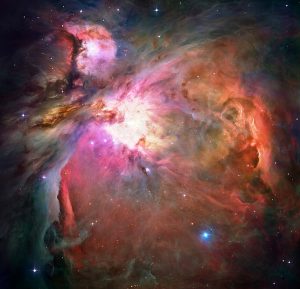
The Great Orion Nebula as imaged by The Hubble Space Telescope.

The Great Orion Nebula as imaged by the Hubble Space Telescope.

Below Orion’s belt, there is another prominent asterism known as Orion’s Sword. It consists of several bright stars, clusters and most notably the Great Orion Nebula.

The brightest star in Orion’s Sword is Hatysa, a multiple-star system member of the star cluster known as “The Lost Jewel of Orion”. Just above Hatysa and appearing as the central star of the Sword asterism, you can find one of the brightest nebulae visible to the naked eye and the closest region of massive star formation to Earth: The Great Orion Nebula.

This magnificent nebula is not just a stunning sight in the Orion constellation; within its swirling clouds of gas and dust, new stars are born, offering us a front-row seat to the fascinating process of star formation. Additionally, it is home to several star clusters, including the Trapezium Cluster, which consists of very hot, young stars casting their intense glow on the surrounding cloud walls.

Because of its brightness, proximity, and status as an active star-forming region, the Great Orion Nebula is one of the most intensively studied celestial objects.

Rigel

Rigel, a prominent star marking the left foot of the constellation Orion the Hunter, is a multiple-star system situated approximately 860 light-years from Earth. Rigel ranks as the seventh brightest star in our night sky, making it a significant point of reference in celestial navigation and a prominent figure in various mythologies.

At the heart of this four-star system lies Rigel A, an impressive white-blue supergiant. Rigel A is considerably more massive than our Sun, with an estimated mass around 20 times greater, and it radiates a luminosity that surpasses that of thousands of Suns.

Close to Rigel lies the faint reflection nebula known as the Witch Head Nebula, characterised by its distinctive shape, featuring a long nose and a pointed chin. The walls of the nebula shine with light reflected from Rigel, creating a stunning display that showcases the cosmos’ unique beauty.

Betelgeuse

Betelgeuse is a spectacular red supergiant star glowing on the right shoulder of Orion the Hunter and is the tenth brightest star in the night sky. Located approximately 600 light-years away, Betelgeuse is one of the largest stars visible to the naked eye, with a radius estimated to be over 700 times that of the Sun. If placed at the centre of our solar system, its surface would extend beyond the asteroid belt, engulfing the orbits of Mercury, Venus, Earth, Mars, and even Jupiter. As recently as 2024, astronomers confirmed the existence of a much smaller star orbiting very close to Betelgeuse, which was named Siwarha.

Betelgeuse is in the late stages of its life due to its massive size and rapid evolution. It is expected to end its life in a supernova explosion, which will be visible even during daylight and may shine as brightly as a half-Moon for several months. In late 2019, Betelgeuse experienced a significant dimming event, known as “The Great Dimming”. During this event, its brightness dropped by about 60%, due to the star ejecting its outer layers and creating a dust cloud that partially obscured it.

Bellatrix

Bellatrix, located on the left shoulder of Orion, is a massive blue giant star. It has a luminosity thousands of times greater than that of the Sun and is relatively young in astronomical terms. Situated approximately 250 light-years away from Earth, Bellatrix is the 26th brightest star in the night sky and the third brightest in the constellation of Orion, following Rigel and Betelgeuse.

Among the bright stars in the constellation Orion, Bellatrix stands out as the first to appear in the eastern sky around midnight in October. As the hours go by, this striking star ascends higher, revealing the magnificent Orion constellation in all its splendour.

Surrounding Bellatrix is a faint nebulosity illuminated by the bright star aptly named the Bellatrix nebula. The interstellar dust in this nebula reflects the intense, brilliant white-blue light of Bellatrix, giving it a similar blue hue.

Saiph

Saiph is an extremely hot blue supergiant marking the right knee of Orion the Hunter. It is approximately 650 light-years away from us, making it closer than Rigel, although it appears less luminous in the visible spectrum because of its intense ultraviolet radiation.

Saiph is 60,000 times as luminous as our Sun, and approximately thirty times as massive. Rapidly losing its stellar mass as its outer layers are expelled into space, this enormous star is expected to end its life in a dramatic stellar explosion known as a supernova.

Meissa

Meissa is a fascinating multiple-star system marking the head of Orion the Hunter, known for its luminosity, surrounding nebulosity, and role as the central star of the Lambda Orionis star cluster.

Located over 1,100 light-years away, Meissa serves as the apex of a triangle formed by Betelgeuse and Bellatrix. Surrounding this massive blue giant star is a large ring of nebulosity thought to be the remnant of a supernova explosion and known as the Lambda Orionis Ring.

Mythology

Orion is one of the oldest recognised constellations, with references found in ancient Greek, Babylonian, Aboriginal and Egyptian cultures.

In Greek mythology, Orion was a giant, supernaturally strong hunter. The constellation depicts him with a club and shield raised against Taurus the Bull. One myth tells of his boast that he would kill every animal on Earth, prompting the gods to send a scorpion to kill him. Having recovered from the scorpion’s sting, he realised how precious life is and repented of his boast. Then the gods placed him in the heavens on the opposite side of the scorpion, allowing Orion to hide as Scorpius rises.

In summary, Orion is a prominent and legendary constellation home to some of the sky’s most spectacular sights. From dying supergiants to the glowing nurseries where new stars are born, Orion is a captivating subject for both stargazers and astronomers alike.

Omara Williams

The Space Traveller’s Lover Volume 2 – Omega Centauri

In The Space Traveller’s Lover, Rothwen is preparing to lead his Invincible Grand Fleet on a takeover mission to Omega Centauri, the last unconquered enclave of the Milky Way for the Rom-Ghenshar, making this his most challenging mission yet.

As Rothwen departs in his flagship, The Prestige, he is confident of victory despite the significant dangers that lie ahead. The themes of his journey and the challenges he faces alongside Shaillah are central to the second volume of The Space Traveller’s Lover.

Let’s eagerly anticipate Rothwen’s adventures as we embark on an imaginative journey to Omega Centauri in this article.

The Milky Way’s biggest globular cluster: Omega Centauri

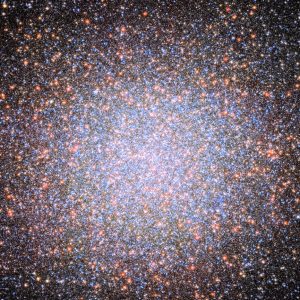
Omega Centauri – By NASA’s Hubble Space Telescope

Omega Centauri – By NASA’s Hubble Space Telescope

Omega Centauri, a breathtaking globular star cluster, is a colossal structure located more than 17,000 light-years away in one of our Milky Way Galaxy’s inner arms, the Norma Arm.

This awe-inspiring star gathering, the most massive globular cluster known, is home to millions of multicoloured stars densely packed within a region approximately 150 light-years in diameter. Its sheer size and grandeur, a spectacle of celestial beauty, have captivated astronomers and stargazers alike.

Visible to the naked eye from dark skies, the cluster appears larger yet fainter than the full Moon. It is the largest and brightest globular cluster in the night sky, making it one of the favourite celestial objects for stargazers in the southern hemisphere.

In the centre of this magnificent cluster, the stars are spaced so closely together that, on average, they are only 0.1 light-years apart. To put this into perspective, this distance is similar to having our closest star, Proxima Centauri, located within the Oort Cloud of our solar system, which is a region of space at the outer edges of our Sun’s gravitational influence.

Omega Centauri is home to ancient stars that are billions of years old—older than our 4.6-billion-year-old Sun. Amidst these celestial giants are other stars of various ages and compositions, creating a stunning tapestry of stellar evolution. This rich diversity of stellar populations hints at a complex galactic origin and dynamic processes shaping this remarkable aggregation of stars over aeons.

If you were to approach Omega Centauri’s core, the sky would be so filled with stars that night would look like day. These stars are racing, especially at the centre of the cluster, hinting at the presence of a supermassive black hole or clusters of neutron stars.

The breathtaking beauty and complexity of Omega Centauri serve as a powerful reminder of the vastness and richness of our universe, inspiring us to wonder: What if we could embark on a journey to Omega Centauri? Imagine traversing the sea of stars, discovering celestial wonders at every turn, and ultimately stopping at a safe distance from the event horizon of its black hole.

We can begin our journey by exploring some fantastic sightseeing treasures as we depart from our home planet. First, we will visit the red supergiant star Antares. Next, we’ll explore the Globular Cluster NGC 6397, followed by the incredible Eta Carina Nebula (NGC 3372) and the glittering star cluster Kappa Crucis (NGC 4755). Finally, we will speed towards Omega Centauri, the extraordinary globular cluster that beckons with its myriads of stars, all glistening like jewels against the cosmic expanse.

The dazzling red supergiant star Antares A

A close-up of the red supergiant star Antares A

A close-up of the red supergiant star Antares A

As we approach the red glowing Antares, we discover that it is a two-star system with contrasting properties. The second star, known as Antares B, is a blue-white main-sequence star that is more massive than our Sun but smaller than Antares A. Together, these stars follow an almost circular orbit as they travel through space. Occasionally, we can observe coronal mass ejections from the red supergiant Antares A, massive bursts of solar wind, plasma, and magnetic fields, impacting the atmosphere of its smaller companion.

Antares A is truly gigantic, approximately 700 times the sun’s diameter, and more than 10,000 times brighter.

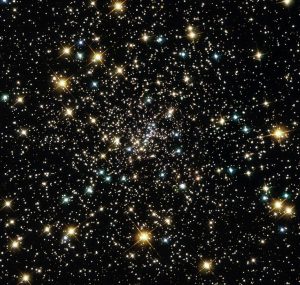
The Sparkling Globular Cluster NGC 6397

Globular Cluster NGC 6397 – By NASA’s Hubble Space Telescope

Globular Cluster NGC 6397 – By NASA’s Hubble Space Telescope

Beneath the vibrant glow of Antares, we glide under the sweeping tail of the Scorpion constellation, venturing south of the celestial equator.

Our attention is drawn to a compact, fuzzy ball of shimmering sapphires and glittering gold. As we approach, this ball unfolds into thousands of stars, each one a dazzling gem in a spectrum of vivid blues, fiery reds, and warm yellows. They radiate outward from a dense, luminous core, creating a stunning tapestry of light.

Now, we find ourselves 7,800 light-years away from Earth, visiting one of the closest globular clusters to our planet.

As we observe the swift, swirling movements of these stars around the dense core, we suspect that deep at the heart of this celestial dance lies something far more massive—perhaps the remnants of multiple neutron stars or the enigmatic presence of a black hole.

The Spectacular Eta Carina Nebula (NGC 3372)

Eta Carina NGC 3372 – By NASA’s Hubble Space Telescope

Eta Carina NGC 3372 – By NASA’s Hubble Space Telescope

Leaving the glowing NGC 6397 cluster behind, we set our course for our next destination: the fabulously mysterious Eta Carina Nebula, drawing us to explore the depths of its complex, star-forming regions.

As we journey into the Carina-Sagittarius arm of our Milky Way, situated 8,500 light-years from Earth, we are immediately captivated by the sight of enormous, dusty lobules radiating from a bright central point.

This expanding superstructure seems to be on the brink of self-destruction at any moment, due to the explosive interactions and stellar outbursts from the binary star system at its core. Composed of a dazzling hypergiant and a smaller, yet highly active companion, these stars produce a combined luminosity that surpasses five million times that of our Sun.

Eta Carinae is estimated to be about 100 times more massive than the Sun, making it one of the most massive stars in our Galaxy.

We cannot help but be in awe of the variety and richness of stellar objects in this region. It features clusters of stars harbouring young, highly active stars and intricately shaped dust-gas pillars, offering a unique insight into the complex interaction of matter in the cosmos.

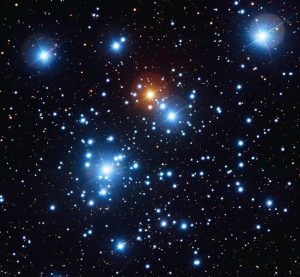
The Jewel Box Kappa Crucis star cluster (NGC 4755)

Kappa Crucis - By ESO Very Large Telescope (VLT)

Kappa Crucis – By ESO Very Large Telescope (VLT)

Leaving the mesmerising cosmic landscape of Eta Carina behind, we shift our focus to the edge of the Crux Arm of our Milky Way, located 6,500 light-years away. Here, we can witness the stunning beauty of the Kappa Crucis open star cluster, also known as The Jewel Box.

The vibrant and colourful cluster is home to hundreds of stars of various types, including hot blue and red supergiants, binary systems, and variable stars.

The picturesque scene resembles a cascade of precious gemstones—diamonds and sapphires—spilt across the vastness of space, with a stunning ruby at its centre. This brilliant ruby-red supergiant stands out distinctly against the blue supergiant stars that surround it, creating a uniquely contrasting celestial spectacle.

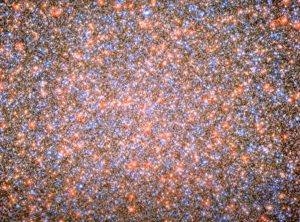
The colossal globular cluster Omega Centauri

An endless sea of stars in Omega Centauri

An endless sea of stars in Omega Centauri

We are now preparing to cross the swirling inner arms within the vast expanse of our Milky Way galaxy, the Crux and Norma arms. As we navigate toward the luminous centre of our galaxy, we turn our attention to the largest globular cluster known to humanity—a colossal celestial gathering shimmering with millions of stars.

This compact and diverse collection of stars, located 17,000 light-years from Earth, promises to reveal the great diversity of our universe as we approach its edge. Each brilliant point of light draws our attention, overwhelming us with its beauty and colour.

We observe red giants shedding their vast coronas into the stellar medium while golden-yellow stars shine with a warm brilliance. Hot, blue young stars often erupt with dazzling, highly energised jets of plasma, outshining the more modest red dwarfs, whose faint glow quietly blends into the all-encompassing light mesh.

As we glide through the expanse of this superdense cluster, our senses are overwhelmed by the radiant glow of countless suns. The vivid luminosity dances before our eyes, while intense, highly energised jets shoot through like cosmic fireworks. This light display is the most sensational we have ever witnessed, and it only becomes more dazzling as we move deeper into this stellar wonderland.

The radiant backdrop of intense light surrounds us like a magnificent wall of brilliance, dotted with countless star-like points. Each shimmering star streaks through the dense, luminous medium, gaining speed as we approach the pulsating core. Here, the concentrated stellar energy seems to coalesce into a vibrant, bubbling fireball, creating an overpowering burst of light and power.

However, advancing any further may lead us perilously close to the immense gravitational pull of the colossal black hole, lurking ominously beyond the blinding curtain of radiant light. This celestial giant possesses the power to trap and consume any matter that approaches within its formidable grasp, a relentless force that embodies both the beauty and peril of this otherworldly realm.

As we move away from danger, we catch a glimpse of a breathtaking quadruple-star system, where each star orbits the others at ever-increasing speeds while eclipsing one another’s bright light. In this complex dance of celestial bodies, each star orbits the others with astonishing velocity, its brilliant light occasionally eclipsing the others in a spectacular dance of shadows and bright illumination.

At the heart of this dazzling vortex, a jet of pure energy erupts in both directions, piercing through the surrounding hot plasma with unfathomable force. The jet’s intense brightness creates a stark contrast against the swirling, turbulent gases, illuminating the region in a surreal white glow.

As we hurriedly retreat into the less dense areas of the star cluster, we reflect on the cosmic mechanics at play. The extraordinary interaction of this complex star system must be the result of neutron stars at the core, whose immense gravitational pull and rapid rotation generate this awe-inspiring burst of energy and power.

We are leaving Omega Centauri with a profound sense of humility. We contemplate the vast wonders and mysteries of the universe, from the shimmering expanse of countless stars to the intricate interactions of physical forces that shape the fabric of reality, revealing a complexity that sparks our curiosity.

It is this insatiable desire to uncover the cosmos’ secrets that drives us forward; with each revelation, the universe grows ever more enchanting, beckoning us to delve deeper into its mysteries.

Omara Williams

The Space Traveller’s Lover: Latest Top Five-Star Amazon Reviews

Dear readers,

I’m bringing you today the latest top five-star Amazon Reviews from June and July 2025

While writing my book, I always had the reader in mind: what would they think? How would they feel? I wanted them to ask themselves what they would do in those situations.

I was determined to take the readers on a mesmerising journey through otherworldly landscapes and incredible conflicts, and this determination made the plot truly unique and original.

This is why feedback from readers is so important to me. It brings me profound satisfaction to encounter comments from readers whose insights reveal that my story has encouraged them to examine our world and their own identities more closely.

Many express feeling as though they were travelling side by side with the characters through the vastness of space, experiencing every challenge and triumph firsthand.

It is deeply rewarding to hear that they couldn’t put the book down, desperate to find out how it would all end.

Ultimately, this feedback is a testament to the power of literature to bring our most profound questions to the forefront.

Here is a summary of my favourite latest feedback about my book:

  • The story explores the conflict between love and duty from a fresh perspective. Through Rothwen’s eyes, we gain a new understanding of ourselves—our contradictions, resilience, and capacity for love.
  • It’s easy to get swept up in the fast-paced plot and emotional moments. I couldn’t stop wondering: Would he betray his mission for her? Would she choose him over saving her planet?
  • This love story is a unique page-turner. The characters and plot are engaging, and the combination of sci-fi and romance truly sets this book apart from the rest. It pulled me in and left me rooting for them against all odds.
  • This book is an excellent blend of sci-fi and romance that will completely captivate you from page one. The author weaves in fresh world-building and thought-provoking ideas that keep the reader engaged and turning the pages.

Find more amazing reviews here!

Top Five-Star Amazon Reviews from June and July 2025

1. Omara Williams creates an intricately constructed story that is equal parts sci-fi, fantasy, and romance. The passionate relationship between the heroine, Erin, and the alien warrior, Rothwen, explores the classic conflict of love versus duty with fresh eyes. This book is a good choice for mature teenaged and adult readers who enjoy these genres. Ruth F Stevens

03/07/2025


 Classic conflict of love versus duty


2. What elevates this novel is its profound exploration of humanity. Through Rothwen’s eyes, we see ourselves anew—our contradictions, resilience, and capacity for love. His transformation from cold conqueror to a being capable of questioning his purpose is rendered with psychological depth rarely seen in space opera.


Olanrewaju Jimoh


 A Breathtaking Collision of Worlds and Hearts


3. The Space Traveller’s Lover is a thrilling blend of action, suspense, and romance. The storyline is engaging, and the characters are well-developed with strong chemistry. It’s easy to get swept up in the fast-paced plot and emotional moments. A great read for fans of sci-fi with a romantic twist.


Lewis Charles


 Exciting and Romantic Sci-Fi Adventure


4. I didn’t think I’d ever root for an alien invader, but this book had me hooked from the first chapter. Rothwen is this intense, deadly alien soldier who’s supposed to destroy Earth, but then he meets Erin and everything changes. I loved their chemistry—it’s this wild mix of tension, danger, and tenderness. The sci-fi stuff is cool and futuristic, but it’s really the love story that kept me turning pages. I couldn’t stop wondering: would he betray his mission for her? Would she choose him over saving her planet? It’s dramatic in the best way and kind of feels like The Hunger Games meets The Host. Definitely recommend if you’re into romance with stakes as high as the stars. John Beauchamp


 Kept me turning pages


5. This love story is a unique page turner. The characters and plot are engaging and the sci fi/ young romance elements really set this book apart form the rest. The characters in this story are well developed and I will keep an eye out for the sequel. Wayne S


 Not your typical love story


6. I picked this up expecting a fun sci-fi adventure, but I got so much more. I was completely hooked by the story and I loved the blend of fast-paced action with a love story. It pulled me in and left me rooting for them against all odds. Christoffer J


 Great book and a good read!


7. This book is an awesome mix of sci fi and romance that’ll totally pull you in from page one. It follows Erin a young woman who finds out shes part alienm as she falls for Rothwen a badass alien soldier. Their love story is intense and a bit dangerous especially with an alien invasion on the horizon. The author does a great job balancing action passion and culture clash. With super vivid scenes and a fast-moving plot, this spacey love story is perfect if youre into sci fi and romance. Cravings1954


 Amazing Sci-fi!


8. Traditional science fiction is packed full of big ideas. This looks into factors such as humans and climate change. The author integrates some fresh world-building and thought-provoking ideas, which keep the reader engaged and turning the pages             AC007


 Gets you thinking about the bigger picture


You are going to love this book!

You are going to love this book!

Explore the wonders of the Andromeda Galaxy and the summer night sky

Dear readers,

In my previous article titled “What to See in the Night Sky This June: From the Summer Triangle to the Galactic Centre”, published in The European Magazine and on this blog, I explored the wonders of the summer night sky. We identified the brightest stars and located the iconic Summer Triangle. We pinpointed the centre of our Milky Way, a dynamic region brimming with countless celestial treasures such as star clusters and gas-dust nebulae, marking the highlight of our journey through the warm summer nights.

In July, we continue to enjoy warm summer nights and the possibility of observing noctilucent clouds. After darkness sets in, we can explore major constellations and their brightest stars, hopping from star to star as we admire the dense, winding band of our Milky Way stretching all the way up through the northeastern sky. Furthermore, we will have the opportunity to spot the Great Andromeda Galaxy, the farthest celestial object visible to the naked eye.

The Andromeda Galaxy

The Andromeda Galaxy

To truly enjoy the experience of stargazing, find a quiet location away from the city lights. Make yourself comfortable as you marvel at the sparkling, star-filled sky while enjoying the cool summer breeze. Although binoculars and telescopes can improve your view, the stunning beauty of the cosmos is captivating enough to appreciate even without them.

Find Capella in Auriga

Facing north, we turn our attention to the Big Dipper, our trusted stellar guide, and identify its second-brightest star, Dubhe, located at the top right-hand corner of the bowl. From Dubhe, draw a line downward to your right toward the northeast. There, we find the striking star Capella, nestled at the top corner of the hexagon-shaped Auriga constellation.

Capella, a quadruple-star system of two binary pairs, is located just 43 light-years away from Earth. It features two yellow giant stars, each about ten times the diameter of the Sun, as well as two much fainter and smaller red dwarfs. Capella’s unique composition and proximity, along with its ranking as the sixth-brightest star in the night sky, make it a fascinating object for both stargazers and astronomers. Its study provides valuable insights into the nature of stars and stellar evolution.

The Auriga constellation, commonly referred to as The Charioteer, is depicted in Greek mythology as the protector of shepherds, carrying a goat in his arms as he rides through the sky in his chariot, bringing much-needed rain to the grasslands.

Find Algol in Perseus

From Capella, follow an imaginary line to the right, toward the east, until you find the distinctive snake-shaped silhouette of the Perseus constellation. Out of its main six stars, two stand out: yellow-white Mirfak, the brightest, and to its lower right, the blue-white Algol, the second brightest but the most famous.

Located 94 light-years away, Algol is a triple star system consisting of a massive blue star, a cooler orange subgiant, and a smaller white star. As these stars orbit and eclipse one another, the brightness of the system varies dramatically over a short three-day cycle. Also known as the Demon Star, Algol is one of the most well-known variable stars in the night sky and is popular among stargazers who closely observe its frequent eclipses.

At the top of Perseus’ curving outline, two clusters of stars appear as fuzzy patches, shimmering side by side. These are known as The Double Cluster, a breathtaking assembly of hundreds of luminous, hot young stars 7,500 light-years away from us. When viewed through binoculars, the fuzzy patches transform into a dazzling display of diamond-like stars, a sight that will surely leave you in awe.

The Perseus constellation is named after the legendary hero Perseus, a central figure in Greek mythology known for his daring feats. He famously killed the fearsome Gorgon Medusa, a creature whose gaze could turn onlookers to stone, and rescued the beautiful Andromeda from the sea monster Cetus.

Find Schedar in Cassiopeia

From the Double Cluster, continue looking upwards until you spot the distinctive W-shaped constellation of Cassiopeia, straddling the wavy band of our Milky Way and its rich region of open clusters, galaxies, supernova remnants and nebulae.

The five main stars of the Cassiopeia constellation are easily visible to the naked eye. The brightest star, Schedar, is found at the bottom right corner of the “W” shape. Occasionally, it can be outshone by Navi, which is positioned at the top central point of the “W”. Due to Navi’s eruptive nature, its brightness can temporarily surpass that of Schedar, as if the two stars were engaged in a never-ending contest for brightness.

Schedar is an orange giant star that is 800 times more luminous than our Sun and is situated about 228 light-years away from us. In contrast, Navi is a blue subgiant star with a much greater luminosity (40,000 times that of the Sun) and located farther away (600 light-years away).

The Cassiopeia constellation is named after Queen Cassiopeia of Ethiopia, known for her beauty and vanity. According to Greek mythology, her conceited behaviour angered the gods, who ordered the destruction of her kingdom. The queen then offered her daughter, Andromeda, to the fearsome sea monster Cetus as a sacrifice to appease the gods.

Find Alpheratz in Andromeda

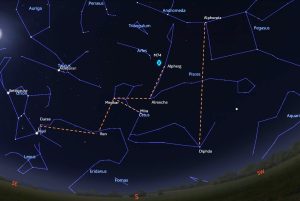
From Schedar, draw a line to your right, toward the east, to locate Alpheratz, shining brightly in the top left corner of the prominent asterism known as the Great Square of Pegasus —a bright and recognisable pattern of stars dominating the eastern sky.

Alpheratz, straddling the boundary between the Pegasus and Andromeda constellations, is officially part of the large but rather faint Andromeda. Alpheratz lies 94 light years away and is a binary system in a close orbit, formed by a blue-white subgiant star 240 times more luminous than the Sun and a smaller white star.

Along the thin line of stars that make up the Andromeda constellation, we can locate the bright red giant star Mirach, one star to the left of Alpheratz. Mirach is a well-known guide for finding the Andromeda Galaxy, the nearest large galaxy to our Milky Way.

A triangle between Schedar, Alpheratz and Mirach frames the Andromeda Galaxy, appearing as a fuzzy patch in dark skies above Mirach. With an estimated trillions of stars and 2.5 million light-years away, this massive spiral galaxy is moving toward us at a speed of 110 kilometres per second. It is expected to collide with our Milky Way in 4.5 billion years, a cosmic event that will reshape both galaxies and the night sky as we know it.

Finding The Andromeda Galaxy

Finding The Andromeda Galaxy

Finding Capella, Algol, Schedar and Alpheratz

Finding Capella, Algol, Schedar and Alpheratz

In Greek mythology, Andromeda is the beautiful princess who was offered as a sacrifice to the gods but was saved by Perseus, who killed the sea monster and freed her from her chains. As soon as they met, Andromeda and Perseus fell in love, and the gods, so touched by their passion, placed them next to each other in the heavens.

The legends behind these constellations tell an extraordinary story filled with challenges, courage, love, and triumph. These myths add depth and intrigue to stargazing, transforming it from merely the observation of stars into a rich narrative that everyone can enjoy.

Main Night Sky Events in July

July 4 – Venus near the Pleiades star cluster

The bright planet Venus, also known as the Morning Star, shines over the eastern horizon and below the dazzling Pleiades star cluster after 2:30 a.m.

July 10 – Full Moon

The Full Moon rises above the southeastern horizon after 9:30 p.m. and then arcs low across the sky toward the south. This full Moon is also known as the Buck Moon, a name derived from Native American traditions since July is the time when male deer, or bucks, have fully developed their antlers.

July 13 – Venus near Aldebaran and The Hyades star cluster.

Venus continues its early morning journey through the Taurus constellation, shining low on the eastern horizon above the bright red-orange star Aldebaran and the Hyades star cluster, softly twinkling nearby.

July 16 – The Moon near Saturn

The waning crescent Moon shines above and to the right of Saturn, visible over the southeastern horizon all night after midnight.

July 21 – The Moon near Venus

The thin crescent Moon meets bright Venus in the Taurus constellation over the eastern horizon after 3 a.m., both positioned to the left of Aldebaran, the Pleiades, and the Hyades star clusters—a unique gathering of glittering celestial bodies that make up a stunning sight.

July 23 – The Moon near Jupiter

The thin crescent Moon meets Jupiter after 4 a.m. as they keep rising over the eastern horizon ahead of the Sun.

July 28 – Peak of the July Gamma-Draconids meteor shower

This meteor shower has shown previous outbursts, and observing conditions are favourable, as the Moon is in a very thin crescent phase. After midnight, find a dark area, lie on your back, relax, look up towards the highest point in the night sky, and start counting the shooting stars.

July 30 – Peak of Delta-Aquarids and Alpha-Capricornids meteor showers.

This time, we have multiple meteor showers occurring on the same night and close to each other, increasing our chances of spotting more shooting stars. Look towards the southeastern sky after midnight to experience the thrill of bright fireballs that will set your heart racing.

You can find another version of this article in The European Magazine here: What to see in the night sky this July: Capella, Cassiopeia and the Andromeda Galaxy – The European Magazine

Experience the beauty of the summer night skies

Dear readers,

Today, I will take on a journey through the warm summer night skies, from noctilucent clouds and the Summer Triangle to the enigmatic Galactic Centre.

In my previous articles, “Let’s take a deep dive into the night sky with the Big Dipper” and “Spot the Big Dipper — and unlock the secrets of the spring sky,” published in The European Magazine, I explained how the Big Dipper can guide you in exploring the spring night sky. I shared tips on finding the brightest stars and locating the Spring Triangle.

As summer approaches, the night sky becomes a stunning display of bright stars, creating captivating constellations and asterisms. Once again, by using the Big Dipper as our starting point, we can explore the June night sky and locate the distinctive Summer Triangle. This trio of stars shines brightly and widely, resembling a giant sail leading us on our journey through outer space.

From the Summer Triangle, we can then pinpoint the super-dense and enigmatic Milky Way’s galactic centre. There, nestled within its depths, lies a supermassive black hole, an immensely powerful object millions of times the mass of our Sun that drags all cosmic matter around it.

During this time of year, as we approach the Summer Solstice on June 21, twilight lingers well into the night, making it challenging to see even the brightest stars. Therefore, it’s important to find observing sites away from light pollution and venture out after midnight for the best stargazing opportunities.

Find Vega in Lyra

To find Vega, let’s return to our great stellar signpost, The Big Dipper, now hanging bowl-down in the northwestern sky. Start by finding Mizar, the star located at the bend of the Dipper’s handle.

From Mizar, draw an imaginary steep line upwards and towards the northeast. This will lead you to glittering Vega, shining brightly in the Lyra constellation, on one of the corners of a small triangle of stars.

Vega is a white main-sequence star that is twice as massive as our Sun and 40 times more luminous. It is relatively close to Earth, located only 25 light-years away, and ranks as the fourth-brightest star in the night sky.

The Lyra constellation’s six main stars form a small rectangle and a triangle connected at one point.  These stars continuously shimmer, seemingly competing with the brilliance of Vega.

In Greek mythology, the Lyra constellation symbolises the lyre that musician Orpheus played to uplift people’s spirits.

Find Altair in Aquila

To locate Altair, face northwest and use Vega as a starting point. Next, extend an imaginary line upward and toward the east, at a slightly steep angle. You will find the next brightest star, Altair, shining above and to the right of Vega. Altair is distinctly positioned at the tail of a group of stars forming a cross shape with angled arms that seem to be soaring towards the southern sky.

Altair is a rapidly spinning white main-sequence star, twice as massive as our Sun and ten times more luminous. At only 17 light-years away, it is one of the closest bright stars to our Solar System. It ranks as the 12th brightest star in the night sky.

The Aquila constellation, also known as The Eagle, resembles a bird in mid-flight with its wings outstretched. In Greek mythology, it represents the eagle owned by Zeus, the king of the gods, which he used to punish Prometheus for giving fire to humanity without his permission. The constellation’s brightest star, Altair, marks the eagle’s head, while other stars outline its wings and body.

Find Deneb in Cygnus

To locate Deneb, face northwest and return to Vega. Next, trace a gently descending line towards the northeast until you spot the next brightest star, Deneb. It is positioned slightly below and to the right of Vega and at the tail of a group of stars forming a cross shape with elongated arms.

Deneb is a blue supergiant star, 20 times larger than the Sun. It has a luminosity nearly 200,000 times greater than our Sun, yet it is located 2,600 light-years away, making Deneb one of the most distant first-magnitude stars visible in the night sky. It ranks as the 19th brightest star in the night sky.

The Cygnus constellation is a prominent group of stars, with its main stars forming an asterism known as the Northern Cross. In mythology, Cygnus is often depicted as a swan, symbolising true friendship. Deneb is located at the tail of the swan, with its wings extending beyond the arms of the cross.

Additionally, the Cygnus constellation is home to the intriguing object known as Cygnus X-1, a double star system consisting of a supergiant star and an unseen massive companion, believed to be a black hole.

Finding Vega, Altair and Deneb

Finding Vega, Altair and Deneb

The Summer Triangle

The stars Vega, Altair and Deneb form a prominent asterism known as the Summer Triangle. These three stars stand out in the night sky due to their significant brightness compared to nearby stars, making the Summer Triangle a captivating feature during the summer months.

The stars within the Summer Triangle showcase a beautiful display of contrast and variety. Vega, the most luminous of the trio, shines with a dazzling bluish-white glow. Altair radiates a warm, crisp white light, while Deneb, the faintest of the three, presents a delicate pale blue-white light that softly lingers in the background. Together, these stars create a unique blend of colours and intensities for a memorable celestial view.

The Summer Triangle: Vega, Altair and Deneb

The Summer Triangle: Vega, Altair and Deneb

Find Antares in Scorpius

To locate Antares, first face south and locate Vega, shining brightly at one corner of the Summer Triangle. From there, draw a slightly steep line downward and to the right toward the southern horizon to spot Antares, a distinctly orange star twinkling low in the southern sky.

Flanked by stars on either side, the brighter Antares is a binary system composed of a massive red supergiant and a hot blue star located 550 light years away. It is one of the largest and most luminous stars visible to the naked eye, ranking as the 15th brightest star in the night sky. The name Antares means “rival of Mars” due to its similarity in colour to the red planet.

In Greek mythology, Scorpius symbolises the scorpion that the gods sent to kill Orion, the Hunter. After Orion recovered from the poisonous sting, Zeus, the king of the gods, placed both Orion and Scorpius in the sky but on opposite sides to prevent any further conflict.

Find Sagittarius and The Galactic Centre

To locate the teapot-shaped constellation of Sagittarius, start from Antares and extend a short line to the left. As you focus your gaze, you will notice the outline of the Sagittarius constellation, reminiscent of a whimsical teapot. Just off the spout, you’ll find the dense region of star clusters and dust clouds marking the vibrant heart of our Milky Way Galaxy.

The centre of our Milky Way galaxy is a treasure trove of fascinating interstellar objects. Although this region may look hazy to the naked eye, binoculars and telescopes reveal a captivating world filled with nebulae, complex star systems, and wispy, shimmering disks of heated gas and dust.


From our perspective, we are looking edge-on into the densest part of our Galaxy, 26,000 light-years away. Here, we maintain a reasonably safe distance from Sagittarius A*, a supermassive black hole with a mass 4 million times that of our Sun. This immense gravitational force at the centre of our Galaxy significantly influences the movement of stars and cosmic matter in its vicinity.

The Sagittarius constellation is also known as The Archer. In Greek mythology, it symbolises a centaur, a half-horse, half-man creature, given the task of protecting the hero Hercules from Scorpius. Sagittarius relentlessly pursues Scorpius, always prepared to attack with his arrow if it poses a threat to Hercules.

Antares, Sagittarius and the Galactic Centre

Antares, Sagittarius and the Galactic Centre

Main night sky events in June

As we approach the summer solstice on June 21, now is the ideal time to look for noctilucent clouds. These high-altitude clouds are visible only during summer nights, appearing for about a month on either side of the solstice. The Sun illuminates the clouds as it remains hidden below the northern horizon, creating stunning iridescent patterns across the dark sky. If you are fortunate enough to see the unique display of electric-blue noctilucent clouds, your late-night skywatching efforts will be well worth it.

Here is the list of more unmissable night sky events this June:

June 7 – Arietids Meteor shower. Occurring all of June, with June 7 as its peak, this meteor shower produces an average of 60 shooting stars per hour. However, because their radiant is too close to the Sun during their peak, the meteors may be challenging to see with the naked eye. Look towards the northeast horizon from 4 a.m., and you may witness these unique daylight meteor showers to the left of bright Venus.

June 11 – Full Moon. This month’s full Moon is known as the “Strawberry Moon”, a name originating from Native American traditions that link full moons to seasonal harvesting and hunting events. In June, this name reflects the ripe season for wild strawberries. You can watch the full Moon rising low on the southeastern horizon, moving toward the south after 10:30 p.m.

June 17 – Mars near Regulus. Gaze upward to the western sky after 10:30 p.m., where Mars will gleam brilliantly to the right of the twinkling star Regulus in the Leo constellation. Don’t miss the breathtaking sight of their contrasting brilliance against the darkening sky just above the horizon.

June 21 – Summer Solstice. This is the time when we find the Sun at its highest position in the sky, marking the longest day and shortest night of the year. The term “solstice” means “to stand still,” referring to the Sun’s apparent pause in its movement toward the north or south. This event marks the official start of astronomical summer and is celebrated worldwide, most notably at Stonehenge in England.

June 22 – The Moon near Venus. Gaze towards the eastern horizon after 3:30 a.m. to witness the waning crescent Moon softly glowing above the radiant brilliance of Venus. This captivating scene offers the perfect backdrop to catch a glimpse of the elusive shooting stars from the Arietids daylight meteor shower, radiating to the left of this celestial duo.

June 27 – Bootids Meteor Shower. These meteors are known for their unpredictable nature; some years, there are hundreds, while in others, only a few are visible. But as they move slowly, it makes them appear brighter and last longer in the sky. During outbursts, they can even create bright fireballs. To watch for them, look towards the western sky after midnight, to the right and above the dazzling star Arcturus in the Boötes constellation.

June 30 – The Moon near Mars. As the month comes to a close, the Moon and Mars will put on a special show. Our celestial neighbours will appear very close to each other over the western horizon after 10:00 p.m. The thin waxing crescent Moon, contrasting with the reddish hue of Mars shining to its right, will create a memorable sight that you won’t want to miss.

With careful timing, a dark sky, and a little patience, the summer night sky offers endless rewards. For those following this seasonal series, the stars of spring have now given way to summer’s rich display – from brilliant constellations and mythological shapes to the hidden heart of our galaxy itself.

Clear Skies!

And a similar version of this article has also been published in The European: What to see in the night sky this June: from the Summer Triangle to the Galactic Centre – The European Magazine


Let’s take a deep dive into the night sky with The Big Dipper!

Dear readers,

In my previous article published in The European Magazine and entitled “How to Discover More Constellations Than Orion“, we explored the night sky, identifying the brightest stars and constellations surrounding Orion.

I hope that I have ignited your interest in stargazing, especially as the nights become milder, the weather improves, and spring arrives with its stunning celestial displays. In this article,  I aim to show you how to uncover additional wonders of the night sky. Fortunately, there exists a multitude of beautiful constellations and stars awaiting your discovery.

The Night Sky in Spring

The Night Sky in Spring

How to spot Ursa Major

Ursa Major is a large and prominent constellation that dominates the Northern sky. If you look towards the southwest after dark, high in the sky, you will notice a pattern that resembles a bowl with a handle. This collection of seven bright stars, known as The Big Dipper, is part of the larger Ursa Major constellation, which includes additional dimmer stars.

In Greek mythology, Ursa Major represents Callisto, a nymph who was transformed into a bear by Hera, Zeus’ jealous wife. Various cultures have different interpretations of Ursa Major; for example, it’s seen as a bear in Native American and Greek traditions, a wagon in European interpretations, and a plough in British culture.

Because Ursa Major is positioned high in the sky during spring evenings, we can use The Big Dipper’s striking arrangement of stars as a guide to navigate the night sky.

The brightest star in Ursa Major is Alioth, situated on the handle and closest to the bowl. However, we will begin our journey from the second brightest star, Dubhe, located at the top right edge of the bowl. Directly below Dubhe, on the bottom right side of the bowl, you will find the star Merak. Together, Dubhe and Merak form an imaginary line that points to Polaris, the North Star.

Ursa Major ( The Great Bear )

Ursa Major ( The Great Bear )

How to spot Ursa Minor

To locate Polaris in the Ursa Minor constellation, let’s start by following the line along the right side of The Big Dipper’s bowl and continue north for a distance four to five times the gap between Dubhe and Merak.

The Ursa Minor constellation consists of seven stars forming a bowl and handle shape similar to that of The Big Dipper, with Polaris at the end of the handle.

Polaris is located almost directly above the Earth’s North Pole, making it a valuable reference point for finding true north. It serves as an important navigational marker as its altitude in the sky corresponds to the observer’s latitude – at the North Pole, Polaris is directly overhead; at the equator, it’s on the horizon.

Polaris is a triple star system. Its primary star is a yellow supergiant that is nearly five times more massive than our Sun and situated over four hundred light-years away.

How to spot Boötes

Returning to the Big Dipper’s handle, let’s follow the curve formed by the handle’s stars as it arcs down toward the southeast to encounter Arcturus in the Boötes constellation. Its distinctive orange sparkle makes it particularly noticeable.

Boötes, the Herdsman, is one of the largest constellations in the northern sky in terms of its area. The name Boötes comes from the Greek word meaning ploughman. According to legend, the gods honoured the son of Demeter, the Greek goddess of agriculture, by placing him in the heavens next to the Big Dipper.

Arcturus, the most prominent star in the constellation Boötes, is a red giant star around forty light years away. It is the brightest star in the spring sky and ranks fourth as the brightest star in the entire night sky. The name Arcturus comes from ancient Greek, meaning Guardian of the Bear, referring to its proximity to Ursa Major and Ursa Minor.

How to spot Virgo

From Arcturus, let’s continue tracing the arc towards the south, a full Big Dipper length, to find the first magnitude star Spica in the Virgo constellation. The name Virgo comes from Latin, meaning virgin. In ancient legends, Virgo symbolises the goddess of fertility and harvest time.

The Virgo Supercluster, which includes our Milky Way galaxy, is located to the right of the Virgo constellation. This enormous structure contains approximately two thousand galaxies and is situated about fifty-four million light-years away from Earth. Notably, some of the brightest galaxies within this supercluster can be observed using amateur telescopes.

Spica is the brightest star in the constellation Virgo and ranks as the fifteenth brightest star in the night sky. It is a binary star system composed of two stars: one is a blue supergiant, and the other is a blue subgiant. Both stars are larger and hotter than the Sun, and they are located approximately 260 light-years away from Earth.

How to spot Leo

Returning to the Big Dipper, we can utilise the two stars situated near the handle, toward the left side of the bowl, to trace an imaginary line southwestward to find Regulus, a first-magnitude star located within the Leo constellation. The term Leo is derived from the Latin word for lion. In Greek mythology, this constellation symbolises the Nemean Lion, killed by the legendary hero Heracles.

The Leo constellation contains nine bright stars that are easily visible to the naked eye. Six of these stars create a shape resembling a backwards question mark, known as The Sickle asterism. Regulus is located at the base of the question mark, marking the lion’s heart. The remaining three stars form a triangular shape that represents the lion’s tail.

Regulus is the brightest star in the Leo constellation and the twenty-first brightest star in the night sky. Its name comes from the Latin term meaning little king or prince. Regulus is a quadruple star system, which consists of two pairs of stars: a primary white-blue star and its companion, along with a binary pair of dimmer stars, eighty light-years away from Earth.

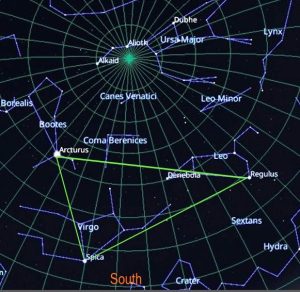
The Spring Triangle

Regulus, Spica, and Arcturus form the prominent Spring Triangle asterism, connecting the constellations of Leo, Virgo, and Boötes. As they rise above the horizon by mid-evening, the Spring Triangle stars signal the approach of warmer, more inviting days ahead. Their twinkling brilliance reminds us of the seasonal transition, inviting stargazers to revel in the beauty of springtime nights.

The Spring Triangle

The Spring Triangle

Main night sky events in May

We wandered through the night sky, using the Big Dipper as our guide to explore beautiful constellations steeped in mythology and showcasing stunning stars. However, if discovering these brightest spring treasures isn’t enough, I invite you to step outside and witness these exciting events happening in May:

May 6 – The Eta Aquariid meteor shower will peak this morning, with an estimated 50 meteors per hour shooting through the skies. The Eta Aquariids are remnants of Halley’s comet, which takes 76 years to orbit the Sun—it was last seen in 1986 and will not enter the inner solar system again until 2061. To view this spectacular meteor shower, head outside in the early hours of May 6 after 3 a.m. and look toward the low southeastern sky. If you happen to miss the peak date, don’t worry; you can still catch glimpses of the meteors until the end of May, though they will be less intense.

May 12 – Full Moon, known as the Flower Moon for the abundance of flowers that bloom this time of year. Although the Moon will be at its farthest from Earth at this time, it may seem bigger because of a peculiar optical illusion that occurs when the Moon is close to the horizon. Look out towards the southeast just after 9:15 p.m. to witness the magnificent rise of this supermoon.

May 23 – The Moon close approach to Venus and Saturn. Look toward the eastern horizon just before sunrise to see the waning crescent Moon at the centre of these two planets, Venus to the left and Saturn to the right.

May 28 – The Moon close approach to Jupiter. Look toward the western horizon just after sunset to see the thin waxing crescent Moon above brilliant Jupiter.

Another version of this article has also been published in The European Magazine. You can find it here: Spot the Big Dipper — and unlock the secrets of the spring sky – The European Magazine


The Space Traveller’s Lover – Latest Top Ten Amazon’s Five Stars Reviews

Dear readers,


In “The Space Traveller’s Lover,” I aim to immerse you in an imaginative world filled with captivating and otherworldly landscapes, while leaving open the possibility that it all could be real.

The emotional rollercoaster of destruction, happiness, and love intertwines, ultimately culminating in a powerful story of defiance and triumph against all odds.

As you progress through each chapter, new revelations unfold, prompting you to consider how you would confront those challenges yourself and what it would take to succeed.

Reading the wonderful reviews of my work and realising how emotionally attached you are to the story and the characters—rooting for them until the unpredictable and impactful end—fills me with pride as an author.

I’m excited to share the latest top ten Amazon reviews from the past two months, which have brought me immense appreciation and joy.

Review Highlights:
  • The tension between loyalty and love had me flipping pages too late into the night.
  • The combination of romance and science fiction felt seamless, with every plot twist occurring at just the right time.
  • It’s about finding light in the darkest places—and how one connection can shift an entire world.
  • A perfect mix of suspense and passion that captures the heart and drags the reader into a love beyond the boundaries of space.
  • If you like your sci-fi with action and emotion, this one’s a great pick. Thought-provoking and hard to put down!
  • With vivid descriptions and an engaging plot, this cosmic love story is a must-read for fans of both genres.
  • A must-read for those who love stories of impossible love and epic stakes.
  • With stunning world-building, a strong female protagonist, and an unforgettable love story, this book is perfect for fans of sci-fi with depth and heart.
  • From the very first page, I was completely captivated by its enchanting blend of fantasy, romance, and adventure.
  • This story gives you page after page of quietly powerful sentences… deep life lessons that will stay with you long after you’ve put this book down.
  • I loved this book. It had just the right amount of romance for a sci-fi love story. The dynamics of the visitors technology is incredible. You’re going to love this book too.
Review List:
1. I wasn’t expecting to get so emotionally invested in a sci-fi romance, but here we are. The tension between loyalty and love had me flipping pages too late into the night. What really got me was how high the stakes felt—not just for the characters but entire worlds. I kept wondering what I’d do in their place, and honestly? I have no clue. The story blends action and emotion in a way that somehow works without getting cheesy. If you’re into star-crossed anything with a good dose of moral conflict, this one hits the mark.


Binshaji, United States, 02/04/25


Love, War, and Major Emotional Whiplash


2. Omara Williams’ “The Space Traveller’s Lover” impressed me with its strong character development and great pacing. Erin starts as a regular student and becomes an important part of an alien conflict. Her journey is exciting and emotional. The combination of romance and science fiction felt seamless, with every plot twist occurring at just the right time. The scene transitions were fluid and cinematic. This remarkable debut effectively merges genres while preserving an emotional essence. It is certainly worth the read!


WendyW, Australia, 02/04/25


Love Between Two Worlds, A Thrilling Sci-fi Romance


3. This book pulls you in with its emotion and heart. Erin and Rothwen’s story is intense, unexpected, and full of that ache you feel when love and loyalty collide. It’s about finding light in the darkest places—and how one connection can shift an entire world.


Woon, United Kingdom, 28/03/25

Good book

4. It’s a breathtaking adventure that combines intergalactic action with overwhelming romance. A perfect mix of suspense and passion that captures the heart and drags the reader into a love beyond the boundaries of space.


Florina, Italy, 17/03/25

Love among the stars, passion and adventure beyond the stars

5. The Space Traveller’s Lover delivers all the classic sci-fi goodness—big ideas, alien invasions, and moral dilemmas—but what really pulls you in is the emotional core. Erin and Rothwen’s relationship brings real depth to the story, balancing out the epic scale with intense, personal stakes.
It tackles climate change, power, love, and what it means to be human, all wrapped up in a fast-paced, twisty plot. If you like your sci-fi with action and emotion, this one’s a great pick. Thought-provoking and hard to put down!
Renee C, United States, 28/03/2025


Loved it!

6. This book is a thrilling blend of sci-fi and romance that will keep you hooked from start to finish. The story follows Erin, a young woman with a hidden alien heritage, as she falls for Rothwen, a powerful alien soldier. Their forbidden love unfolds against the backdrop of an impending alien invasion. The author skillfully weaves together themes of duty, desire, and cultural clash. With vivid descriptions and an engaging plot, this cosmic love story is a must-read for fans of both genres.


Vinney, United States

19/03/2025


 Interstellar Romance Meets Alien Invasion


7. I loved this book. It had just the right amount of romance for a sci-fi love story. The dynamics of the visitors technology is incredible. You’re going to love this book too. DDLR, United States, 02/03/2025


5.0 out of 5 stars This was a very enjoyable read. The magnitude of the storyline kept me reading all the way through


8. The Space Traveller’s Lover is a mesmerizing blend of sci-fi adventure and heart-pounding romance. Omara Williams masterfully weaves action, emotion, and thought-provoking themes into a gripping narrative that keeps you hooked from start to finish. With stunning world-building, a strong female protagonist, and an unforgettable love story, this book is perfect for fans of sci-fi with depth and heart. If you love high-stakes adventure, powerful emotions, and fresh, imaginative storytelling, this is a must-read! Ana Lutcan, United States, 16/03/2025


 A Thrilling Sci-Fi Romance That Captivates


9. From the very first page, I was completely captivated by its enchanting blend of fantasy, romance, and adventure. The story transported me to a mesmerizing universe filled with breathtaking worlds, deep emotions, and unexpected twists. The characters were beautifully written, and I found myself deeply invested in their journey. The romance was both heartfelt and intense, making me feel every moment of longing, passion, and discovery. The chemistry between the protagonists was undeniable, and their love story felt truly magical. What I loved most was how the book seamlessly combined fantasy with elements of space exploration, creating a unique and immersive experience. The vivid descriptions and poetic writing style made every scene feel alive, as if I were traveling alongside the characters.


Galyna B, United States, 07/03/25


5.0 out of 5 stars
 I recommend this book for reading.


10. The Space Traveller’s Lover sounded so intriguing and it certainly was! This story gives you page after page of quietly powerful sentences… deep life lessons that will stay with you long after you’ve put this book down. Pablo K, United States, 02/03/25


5.0 out of 5 stars I read this book in bed, on the way to work, whenever I had free time.


Discover more reviews here: Reviews – Omara Williams


How The Night Sky Ignited My Imagination and Passion for Storytelling.

Dear readers,

I have always been fascinated by the night sky, filled with the brightest stars and planets, meteor showers, and occasional comets. I learned the constellations and the locations of their brightest stars, which allowed me to navigate the night sky with ease. Soon, skywatching became one of my favourite hobbies, and I dedicated long hours to it each night. As I travelled the world, purchased telescopes, and attended star parties, my fascination grew even stronger.

One of my favourite pastimes was imagining what it would be like to fly from Earth to another star, journeying through the dust clouds and nebulae of the Milky Way along the way. This allowed me to truly feel connected to the Universe.

I would later incorporate some of these imaginative interstellar trips, along with some of my skywatching experiences, into my debut sci-fi novel “The Space Traveller’s Lover”.

For example, in Chapter 16, “The Visitor”, I write:

Out in the open, she saunters through the fields with her arms fully open while her gleeful eyes stay fixed on the starry sky. “So far and yet so close,” she says to herself as she glances through the constellations, taking her time to admire the glittering starlit night. She watches the prominent Orion stars shining over the horizon, then focuses on the less conspicuous Eridani system, waving its dim pearly wreath right off the bright star Rigel. She watches each faint point of light on its wavy river-like pattern, feeling as if her ancestral home is calling on her, and she is responding.

I hope you enjoy today’s article as I guide you in identifying the brightest stars in the early spring sky…

EARLY SPRING NIGHT SKY

With the arrival of the spring equinox on March 20th, we officially entered astronomical spring in the Northern Hemisphere. As the days grow longer, skywatching becomes increasingly challenging. Additionally, the brightest constellations that grace our skies during winter, such as Orion and Taurus, fade from view, sinking below the horizon earlier with each passing evening. They will vanish from the night sky until next season.

Yet, in early spring, we can still enjoy winter’s enchanting celestial wonders. The night sky is alive with unique sights that await the curious observer. By using the now-fading constellations as guiding stars, we can embark on an exciting exploration of the night sky.

SKYWATCHING TIPS

For optimal stargazing, it’s essential to select a viewing location well away from the pervasive light pollution of urban areas. The best time to observe is after twilight has ended and the moon is absent, as this maximises our opportunity to behold these celestial gems in all their glory. Even without telescopes or binoculars, we can still marvel at and be awestruck by the beauty of the brightest stars.

ORION AND BETELGEUSE

As April arrives, the early Spring southwestern sky is dominated by its most striking constellation, Orion the Hunter, notable for its distinctive hourglass shape, evoking the image of a mighty hunter poised gracefully among the stars. Orion captivates observers with its brilliant belt, a trio of luminous stars halfway through the hourglass, sparkling like diamonds against the darkened sky. For millennia, the Orion belt’s celestial trio of stars has served as a beacon for human wonder and legends. Its unique alignment has been associated with the positioning of monuments from ancient civilisations, such as the Mayans and Egyptians.

In the top left corner of Orion’s shoulder lies Betelgeuse, the tenth-brightest star in the sky, shining like a fiery ruby in the night sky. This red supergiant variable star is so enormous that if placed at the centre of our solar system, its surface would extend beyond the orbit of Jupiter.

CANIS MAJOR AND SIRIUS

Tracing a 45-degree line downwards from Betelgeuse toward the southeast, it directs our gaze to the sparkling star Sirius, the brightest in the night sky. Sirius is a binary star system made up of a main-sequence primary star and its white dwarf companion. Situated within the Canis Major constellation, which represents the large dog that follows Orion the Hunter, Sirius enchants viewers with its vibrant luminosity.

CANIS MANOR AND PROCYON

If you look above Sirius, the next bright star you’ll see is Procyon in the Canis Minor constellation, the eighth brightest star in the night sky. At less than twelve light years away, Procyon is one of our Sun’s closest stellar neighbours, making it a key subject for stellar studies.

The three stars, Betelgeuse, Sirius, and Procyon, form a striking upside-down triangle dubbed “The Winter Triangle”. This beautiful asterism is part of a larger formation known as “The Winter Hexagon”. By tracing along the edges of this hexagon, we can discover even more cosmic treasures.

GEMINI AND CASTOR AND POLLUX

Continuing our celestial exploration, if we ascend from Procyon at a 45-degree angle toward the west, a pair of side-by-side stars come into view: Pollux and Castor, both residents of the Gemini constellation. Pollux, the more prominent of the two, radiates with a golden glow, while Castor displays a softer white light. Pollux is a yellow-orange giant, while Castor is a fascinating multiple-star system composed of six individual stars organised into three binary pairs, including a mix of main-sequence stars and red dwarfs.

AURIGA AND CAPELLA

A slight descent and westward movement leads to Capella, the sixth brightest star in the night sky, shining prominently in the Auriga constellation. The closest first-magnitude star to the North Celestial Pole, Capella served as a navigational star for ancient sailors. It is also a multiple-star system consisting of two binary pairs: two yellow giants that closely orbit each other and two red dwarf stars.

TAURUS AND ALDEBARAN

Tracing downward and eastward from Capella at a 25-degree angle, our attention is captured by the stunning orange-red star, Aldebaran, a prominent feature of the Taurus constellation. Also known as the Bull’s Eye, Aldebaran is a colossal red giant that visually aligns with The Hyades, the nearest open star cluster to Earth. To Aldebaran’s right, we encounter the dazzling cluster of bright blue stars named The Pleiades, while to the left, on Orion’s upper right shoulder, the brilliant blue giant Bellatrix sparkles with a striking blue-white brilliance. Sometimes called the “Amazon Star”, Bellatrix has been associated with warrior women in various mythologies.

ORION AND RIGEL

From Aldebaran, if we pivot downward and eastward at a 45-degree angle to reach the last node of the hexagon, we find Rigel, the brightest star in the Orion constellation and the seventh brightest star in the night sky. Rigel is a luminous blue supergiant and part of a multiple-star system that includes a close binary pair of smaller stars. Currently in an advanced stage of its stellar evolution, Rigel is expected to meet its end in a dramatic supernova explosion, which might leave behind either a neutron star or a black hole.

THE WINTER HEXAGON

In our exploration of the six prominent stars that form “The Winter Hexagon”—Sirius, Procyon, Pollux, Capella, Aldebaran, and Rigel—we also looked at the three brightest stars in the Orion constellation- Rigel, Aldebaran, and Bellatrix– along with their notable neighbours. I hope this serves as a helpful introduction to navigating the night sky.

For those looking to enhance their stargazing experience, a variety of user-friendly apps, such as Sky Tonight, Night Sky, and Stellarium, can provide invaluable assistance in accessing and exploring the celestial world. Clear skies!

Orion the Hunter and the Winter Hexagon

Orion the Hunter and the Winter Hexagonhttps://www.omarawilliamsbooks.com/

The European has also published a version of this article here: How to get more constellations than Orion under your belt – The European Magazine

Enjoy!